Native Plants

Q. Who is Mr. Smarty Plants?
A: There are those who suspect Wildflower Center volunteers are the culpable and capable culprits. Yet, others think staff members play some, albeit small, role. You can torture us with your plant questions, but we will never reveal the Green Guru's secret identity.

Did you know you can access the Native Plant Information Network with your web-enabled smartphone?

Ask Mr. Smarty Plants
Ask Mr. Smarty Plants is a free service provided by the staff and volunteers at the Lady Bird Johnson Wildflower Center.

rate this answer

Sunday - April 24, 2011
From: Arlington, TX
Region: Southwest
Topic: Herbs/Forbs
Title: Companion planting with heartleaf skullcap from Arlington TX
Answered by: Barbara Medford
QUESTION:
What can I plant with heart-leaf skullcap when it goes dormant in the summer?ANSWER:
Scutellaria ovata (Heart-leaf skullcap) is a perennial, evergreen in winter, 1-3 ft. tall, and blooms blue, violet from April to June. According to this USDA Plant Profile map, it does not grow natively in North Central Texas, but rather in Central and East Texas. We are not sure what you mean as "dormant," perhaps the non-blooming period after June? If that is true, we will presume you are looking for a companion plant that will provide color in the area into the Summer and Fall.
We will look at plants native to North Central Texas, both annual and perennial, and assume they can do well in the same environment in which your skullcap is located. On our webpage on this plant (which you can read in full by following the plant link above) is this information: "Native Habitat: In open woodlands, along roads, and on brushy slopes in East and South Texas. Moist sand, loam, clay, limestone." Also on that page are the Growing Conditions for skullcap:
"Light Requirement: Part Shade , Shade
Soil Moisture: Moist
Conditions Comments: Heart-leaf skullcap is an under-utilized plant for gardens. The showy blue flowers bloom on spikes similar in form to Salvia sp. It colonizes vigorously by underground, fleshy roots. Oily glands on the leaves make it possibly deer resistant. In winter, heartleaf skullcap displays evergreen foliage. Nectar source for adult butterflies."
In terms of planting other plants in the same bed, we would call your attention to the sentence "It colonizes vigorously by underground, fleshy roots." This plant is a member of the Lamiaceae, or Mint family, which is well known for vigorous colonization, if not invasiveness, sometimes impeding the establishment of other plants. We will go to our Recommended Species section, click on North Central Texas on the map; then, on the right-hand sidebar, select on "herb" (herbaceous blooming plant" under General Appearance, and the blooming months of June, July, August, September and October, and Narrow Your Search, which gave us 37 choices. We have four examples of plants that we like below; you should read every webpage on those four, and then look at other possibilities, paying attention to the amount of sunlight and moisture available.
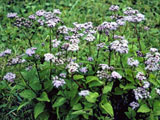
Conoclinium coelestinum (Blue mistflower) - perennial, 3 ft tall, blooms blue July to November
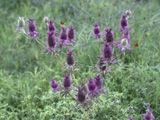
Eryngium leavenworthii (Leavenworth's eryngo) - 3 ft. annual, purple July to September
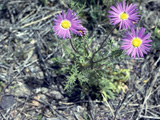
Machaeranthera tanacetifolia (Tahoka daisy) - 1 ft., annual, blooms blue June to October
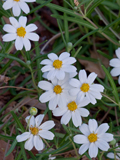
Melampodium leucanthum (Blackfoot daisy) - 1 ft., perennial, blooms white March to November
From our Native Plant Image Gallery:
More Herbs/Forbs Questions
Plants resistant to salt spray in FL
December 18, 2011 - What type of plants can I put in a small planter bed next to a waterfall with a saltwater pool?
Everything I put in there dies.
I live in Southwest Florida.
view the full question and answer
Finding a source of Straggler daisy
October 14, 2015 - I've decided on Straggler daisy but am having trouble finding it. It would be perfect for me. Do I have to wait until next Spring for it to show up? Can it be ordered through a nursery or a landscape...
view the full question and answer
Toxicity of barren strawberries
April 30, 2012 - Are barren strawberries toxic? .
view the full question and answer
Milkweed with the biggest pods in Smith County, TX?
September 11, 2009 - I live in East Texas and I would like to know which of the milkweed plants bears the largest seed pod. I would also like to know the best time to locate the pods in and around the Smith County area.
view the full question and answer
Straggler daisy as a ground cover in Florida
April 21, 2015 - I live in Hillsborough county,FL. My yard has two large oak trees and is very shady. I am looking for a shade resistant ground cover that will do well for a yard used by children to play.
I was told...
view the full question and answer
| Support the Wildflower Center by Donating Online or Becoming a Member today. |