Native Plants
Q. Who is Mr. Smarty Plants?
A: There are those who suspect Wildflower Center volunteers are the culpable and capable culprits. Yet, others think staff members play some, albeit small, role. You can torture us with your plant questions, but we will never reveal the Green Guru's secret identity.
Did you know you can access the Native Plant Information Network with your web-enabled smartphone?

Ask Mr. Smarty Plants
Ask Mr. Smarty Plants is a free service provided by the staff and volunteers at the Lady Bird Johnson Wildflower Center.

rate this answer

Saturday - April 23, 2011
From: Austin, TX
Region: Southwest
Topic: Best of Smarty
Title: Smell barrier around chicken pen in Austin
Answered by: Barbara Medford
QUESTION:
What are some shade to part-shade loving, aromatic plants (akin to Lavender or Jasmine) that will do well in Central TX? I'm trying to plant things around my chicken pen that'll create a smell barrier. I'd choose Lavender, but there is a significant degree of shade there.ANSWER:
If we understand you, you are looking for a plant that will grow in shade and emit a pleasant fragrance that is strong enough to counterract the smell of the chicken pen. We have to say, we don't ever remember being asked that question before, which makes it hard to rely on previous experience. To be honest, we think that sufficient distance is about all that would really help, but we'll see if there is a native plant that might be of some use.
First, both jasmine and the various aromatic Meditteranean herbs, like lavendar and rosemary, are non-native to North America. The Lady Bird Johnson Wildflower Center is committed to the growth, propagation and protection of plants native not only to North America, but to the area in which those plants grow natively. Jasmine originates in China, and the lavendar and rosemary in the Meditteranean Basin.
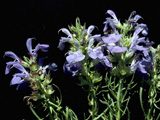
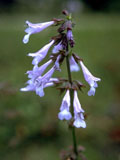
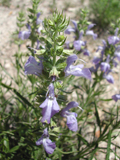
Many of the aromatic plants belong to the Lamiaceae or mint family, and some members of that family are native to the Austin area; for instance, Salvia roemeriana (Cedar sage). Some sages have pleasant blooms and fragrances and will grow well in part shade (2 to 6 hours of sunlight daily) or shade (less than 2 hours of sun). Another possibility is Morella cerifera (Wax myrtle), a medium size shrub, which is evergreen, and the leaves have a pleasant fragrance when they are disturbed.
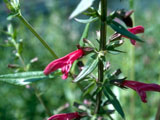
We are going to list some other sages native to this area, and you can follow each plant link to get more information on these plants. Frankly, we don't think this is going to do what you want it to. These plants have pleasant fragrances to attract pollinators, not to serve as chicken pen fresheners. We would suggest moving the nose or moving the pen.
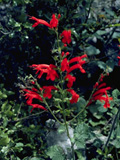
Salvia coccinea (Scarlet sage)
Salvia engelmannii (Engelmann's sage)
Salvia pentstemonoides (Big red sage)
From the Image Gallery
More Best of Smarty Questions
Leaves turning brown in Fredonia KS
June 16, 2009 - Leaves turning brown.
view the full question and answer
Mowing Bluebonnets
March 20, 2004 - When is it safe to mow Bluebonnets?
view the full question and answer
Why is my Weeping Fig crying leaves?
July 27, 2009 - I have a weeping fig that I bought Memorial day in Birmingham, Al. It has 8 or 9 trunks growing altogether. It sits on a porch with eastern exposure, only about 2 hours of sun. It has been losing l...
view the full question and answer
Learning to garden from Hartford CT
May 04, 2014 - Hello, I just recently found an interest in gardening, and have discovered "cultivars." I am having trouble finding what exactly a cultivar is, and if they are bad or not. Can culltivars ever occur ...
view the full question and answer
Pot on a pillar in a pond in Pflugerville
April 26, 2010 - No question: Just a thanks to Barbara. You can't imagine how hard I laughed when I read the interpretation that I was going to plant Maximilians in a pot on a pedestal in the middle of a pond!!! S...
view the full question and answer
| Support the Wildflower Center by Donating Online or Becoming a Member today. |