Native Plants

Q. Who is Mr. Smarty Plants?
A: There are those who suspect Wildflower Center volunteers are the culpable and capable culprits. Yet, others think staff members play some, albeit small, role. You can torture us with your plant questions, but we will never reveal the Green Guru's secret identity.

Did you know you can access the Native Plant Information Network with your web-enabled smartphone?

Ask Mr. Smarty Plants
Ask Mr. Smarty Plants is a free service provided by the staff and volunteers at the Lady Bird Johnson Wildflower Center.

rate this answer

Thursday - April 21, 2011
From: hockley, TX
Region: Southwest
Topic: Wildflowers
Title: A bounty of options for planting natives in Hockley Texas
Answered by: Leslie Uppinghouse
QUESTION:
I have about 1 acre of land in Hockley Texas, outside Houston, that we had cleared of shrubs and poison ivy. We kept the trees so there are some areas with mostly shade and some areas with partial sun, no full sun areas. Part of the area cleared is a dry creek bed. What type of grass and or wild flowers can I seed to grow over what is now just dirt? We don't have a watering system so I would be limited on how much I could water it and long term I don't want to water at all. I don't plan on mowing much and prefer a more natural look. I am ok with higher growing native style grass. Also, we've had 2 companies recommend sodding the side of the creek bed to quickly hold it from erosion, one suggested St. Aug, the other said Bermuda. Which is best to use on the side of the creek bed or is there something else? This creek does not seem to flow very often. Thanks for any help you can provide.ANSWER:
Hockley Texas in Harris County, is where the Gulf Coast prairie and marshes meet the Piney Woods in east Texas. This gives you some interesting options for planting local natives. You have both sun and shade and you have an interesting feature; the dry creek bed.
Bermuda grass, once established is difficult to remove. It grows fast and spreads by thin underground runners. Contractors and folks who instal septic systems like you to use Bermuda as it is fast growing and aggressive enough to hold in bare soil. St. Augustine is less aggressive but still not the best choice if you are looking for a natural look. A combination of native flowers and grasses that will hold the ground in place would be a better choice, especially if you are looking for a low maintenance and a low water usage solution.
We can do a combination search for recommended species with our web site to bring up plants that will work in your area. Under the explore plants tab, click on the recommended species tab that drops down. A map will appear and here you will see that Harris County just squeaks into the East Texas zone. Click on the map in the area of east Texas and this will bring up 133 recommended plants. On the right hand side of this you can narrow your search. If you have the time, take a look at the original found set to give you some idea of the options you have.
For grasses you should have a combination of warm season and cool season grasses. The difference between the two would be when the grass is in it's growing season. Warm season grasses generally have larger root systems and take longer to become established, so you need to partner them with cool season grasses. This way you can have grass quickly to mix with wildflowers so the area doesn't wash away or become infested with weeds.
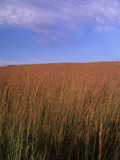
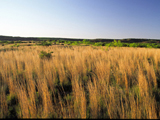
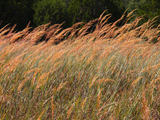
Andropogon gerardii (Big bluestem) is a warm season grass and called King of the Prairie by many, for good reason. It reaches a height of 3 to 4 feet and the roots can travel 12 feet underground. If you click on the link for Big bluestem and look at the growing conditions you will see a couple of things that seem contradictory. It can grow both in sun or part shade, also it prefers moist soil but has a high drought tolerance. The deep roots of the Big bluestem can reach water that other grasses can't. Once established it can also take flash flooding without washing away. Big bluestem would be a great choice for the banks of your dry creek bed.
There are three other grasses that are good companions to the Big bluestem: Sorghastrum nutans (Indiangrass), Schizachyrium scoparium (Little bluestem), and Panicum virgatum (Switchgrass). Click on these links to learn more about them. The other grass to add to this bunch would be Elymus canadensis (Canada wildrye or canada wild rye) as it is a cool season grass. In combination to your warm season grasses you should have greenery all year long.
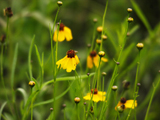
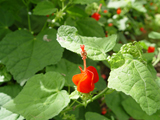
In flowers you have a lot of choices. Some favorites for your area that would do fine in the partial shade and sun would be: Malvaviscus arboreus var. drummondii (Turk's cap or turkscap) adding some bright reds to your shadier areas. Asclepias tuberosa (Butterflyweed) a great butterfly draw. Salvia coccinea (Scarlet sage) is again a good red for shade or sun, also a draw for hummingbirds. Dracopis amplexicaulis (Clasping coneflower) for some yellow, Monarda citriodora (Lemon beebalm) a staple for any land restoration in east Texas. Chamaecrista fasciculata (Partridge pea) attracts many bees and butterflies, also an important grazing plant to small mammals. Coreopsis tinctoria (Plains coreopsis) and Phlox drummondii (Annual phlox) would be two nice self seeders to add.
If you find the idea of planting such a variety of species daunting, seed mixes are a great way to go. The Native American Seed company has wonderful mixes for specific needs and areas in Texas.
Good luck on the project. It is exciting to see transformations in your landscape that you create. Keep a diary of the process and don't forget to take some before and after photos. You should be pleasantly surprised at how fast your new oasis will come to life.
More Wildflowers Questions
How do I grow bluebonnets in East Texas?
April 03, 2009 - I live in the Piney Woods region in N.East Texas. I bought a flat of bluebonnets and want to know if they will grow back next year? If not, how do I get bluebonnets to grow back every year in my yard ...
view the full question and answer
Is purple coneflower native to Colorado?
July 20, 2009 - I have seen the purple cone flower growing wild in Gunnison National Forest in Colorado. Is it a native to that state or has it been brought in?
view the full question and answer
Native wildflowers for farm in Virginia
December 24, 2008 - I am looking for wildflowers native to VA to spread in various beds around our Virginia Beach farm - does a mix exist, similar to what would have been spread along highways, that you can help me locat...
view the full question and answer
Propagation of wildflower seeds
November 13, 2008 - I recently planted seeds for bluebonnets, winecups and pink evening primrose. The bluebonnets have germinated and are growing, but no sign of the other two.
Do the winecups and pink evening primro...
view the full question and answer
Slope Erosion control for Fairview NC
August 19, 2012 - Please recommend plants to help with soil erosion on a slope. The soil is red clay and area gets full sun. The slope is approximately 12' x 12'. I live in Fairview, NC
view the full question and answer
| Support the Wildflower Center by Donating Online or Becoming a Member today. |