Native Plants

Q. Who is Mr. Smarty Plants?
A: There are those who suspect Wildflower Center volunteers are the culpable and capable culprits. Yet, others think staff members play some, albeit small, role. You can torture us with your plant questions, but we will never reveal the Green Guru's secret identity.

Did you know you can access the Native Plant Information Network with your web-enabled smartphone?

Ask Mr. Smarty Plants
Ask Mr. Smarty Plants is a free service provided by the staff and volunteers at the Lady Bird Johnson Wildflower Center.

rate this answer

Sunday - April 10, 2011
From: Fredericksburg, VA
Region: Mid-Atlantic
Topic: Wildflowers
Title: Bluebonnets and paintbrush for Fredericksburg VA
Answered by: Barbara Medford
QUESTION:
Can I broadcast Texas bluebonnets and Indian Paintbrush seeds, in Virginia, during early Spring and get germination; or, do I need to winterize and plant next spring.ANSWER:
This is the kind of question we sometimes wish we could answer with "no, no, no and no." But that would be rude and we don't want you to have bad feelings about the Texas State Flower, so let us try to explain. Please begin by reading some of our How-To Articles: Gardening with Native Plants, How to Grow Bluebonnets. Next, please follow these links to our pages on Lupinus texensis (Texas bluebonnet) and Castilleja indivisa (Entireleaf indian paintbrush). Also, from a previous answer:
Sorry, you can lead a seed to dirt, but you cannot make it grow. Lupinus texensis (Texas bluebonnet) is endemic to Texas, although there has been some success in growing it in Florida, Louisiana and Oklahoma. Inside every seed there are millennia of genetic coding that say "grow here, not there."
There are so many different factors that cause this that some have probably not been identified yet. From our Native Plant Database on the Texas bluebonnet, here are the Growing Conditions:
"Growing Conditions
Water Use: Low
Light Requirement: Sun
Soil Moisture: Dry
CaCO3 Tolerance: High
Soil Description: Limestone/chalky, Sandy Loam, Limestone-based, Calcareous, Sandy, Medium Loam, Clay Loam, Clay, Caliche"
Castilleja indivisa (Entireleaf indian paintbrush) often grows with bluebonnets to draw on the nitrogen in the soil from the legume Lupinus and is the most likely of the Castilleja genus to share space with bluebonnets. Here are their Growing Conditions:
Water Use: Medium
Light Requirement: Sun
Soil Moisture: Dry
Soil pH: Acidic (pH<6.8)
Soil Description: Sandy soils. Sandy Loam, Sandy, Medium Loam, Clay Loam, Clay
Conditions Comments: The roots of this plant will grow until they touch the roots of other plants, frequently grasses, penetrating these host roots to obtain a portion of their nutrients. Transplanting paintbrush may kill it.
You can always try broadcasting some seeds of both whenever you choose, and see if anything comes up. Bluebonnets are Winter annuals, which mean they are planted in the Fall, germinate in the earth, begin to show rosettes above ground around Christmas, and are blooming by the end of February. Is this going to happen in the east central coastal area of Virginia?
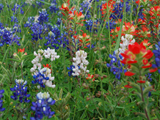
From the Image Gallery
More Wildflowers Questions
Best planting time for wildflower seeds in Austin, TX
February 13, 2007 - When would be the best time to plant wild flower seeds and mow an area where we want to grow wild flowers in Austin Texas?
view the full question and answer
Desmodium spp. (beggar's lice) in Leander TX
November 11, 2011 - Our home backs up to a greenbelt on Blockhouse Creek in Williamson County, Texas (FM 1431 and Parmer Lane). The combination of the flood and drought has left our beautiful greenbelt with an abundance...
view the full question and answer
Flowers for sandy loam and sun in Fayette Co., Texas
May 15, 2007 - Hi I am looking to know what the best flowers are to plant in sandy loam and no shade?
view the full question and answer
Viewing times for wildflowers from Ouchitas to Austin
November 03, 2006 - I'm a geographer and wildflower enthusiast considering a spring visit to the Austin area and want to find out the best time to view wildflowers and farm crops around Austin and also on the drive from...
view the full question and answer
Establishing a wildflower meadow in Madison GA
January 21, 2010 - Can a wildflower meadow be established by seeding in a sunny pasture without removing all existing vegetation, just mowing low and slightly loosening soil with the teeth on a front end loader?
view the full question and answer
| Support the Wildflower Center by Donating Online or Becoming a Member today. |