Native Plants

Q. Who is Mr. Smarty Plants?
A: There are those who suspect Wildflower Center volunteers are the culpable and capable culprits. Yet, others think staff members play some, albeit small, role. You can torture us with your plant questions, but we will never reveal the Green Guru's secret identity.

Did you know you can access the Native Plant Information Network with your web-enabled smartphone?

Ask Mr. Smarty Plants
Ask Mr. Smarty Plants is a free service provided by the staff and volunteers at the Lady Bird Johnson Wildflower Center.

rate this answer

Saturday - April 16, 2011
From: Buford, GA
Region: Southeast
Topic: Erosion Control
Title: Preventing erosion on a sloping lot
Answered by: Janice Kvale
QUESTION:
I am trying to find a native plant to use on a sloped area in my back yard to help prevent the slope from eroding away (zone 7- N. Atlanta, GA). I want something evergreen, between 6 to 30 inches tall, and somewhat fast growing. The slope gets about a half day's sun and ends in a natural wooded/stream area. Thank you!ANSWER:
My goodness! Georgia must be a hilly place as we get many requests for slope plantings there. I am going to consider your request specifically but you may want to check other responses to this problem. To do so, click on Mr. Smarty Plants on our web site, in the upper right corner under Search put "plants for a slope in Georgia", and be amazed at the response.
To prevent erosion on a slope, you want a plant that forms a dense, fibrous root system. That usually means grasses, sedges or ferns. Grass tends to grow tall; ferns and sedges are evergreen and closer to your height preference. I've selected some plants close to matching your height requirements. Light requirement for a sun-loving plant is 6 or more hours daily, for part shade 2-6 hours, and less than 2 hours for shade. Many plants are quite tolerant of any amount of light and/or moisture. Here are a few for you to consider.
Grasses
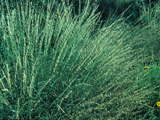
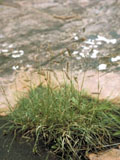
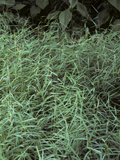
Bouteloua curtipendula (Sideoats grama) 2-3 feet; sun, part shade.
Bouteloua hirsuta (Hairy grama) 10-18 inches; part shade.
Muhlenbergia schreberi (Nimblewill) 1-2.5 feet; part shade, shade.
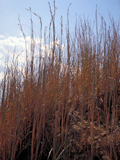
Schizachyrium scoparium (Little bluestem) 18-24 inches dense mound, will shoot stems to 3 feet in fall; sun, part shade.
Sedges
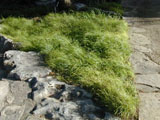
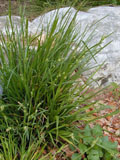
Carex cherokeensis (Cherokee sedge) 12-18 inches; part shade.
Carex texensis (Texas sedge) 10-12 inches; sun, part shade.
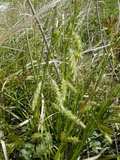
Carex blanda (Eastern woodland sedge) 1-3 feet; sun, part shade, shade.
Ferns
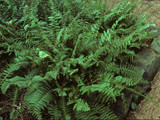
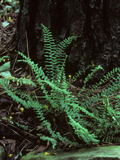
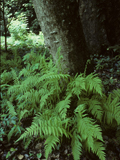
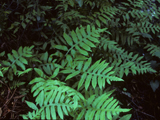
Polystichum acrostichoides (Christmas fern) 1-2 feet; part shade, shade; easily established.
Asplenium platyneuron (Ebony spleenwort) 12-18 inches; part shade, shade.
Thelypteris noveboracensis (New york fern) 12-18 inches; part shade, shade; spreads rapidly into dense colonies.
Woodwardia areolata (Netted chainfern) 1-2 feet; part shade, shade; appropriate near the pond.
Shrub
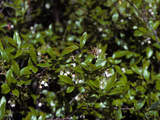
Gaylussacia dumosa (Dwarf huckleberry) 3-15 inches; part shade; slower growing ground cover that thrives at margins of ponds.
More Erosion Control Questions
Establishing wildflowers on a slope in Virginia
August 18, 2012 - From Roanoke Virginia. I have a steep bank rising from one side of my driveway to woods above. Different areas vary from full sun, to half day shade. It is possible to carefully walk/stand on it, we a...
view the full question and answer
Ground cover for a slope in San Antonio TX
July 02, 2013 - Slope growing, no or little irrigation ground cover. The slope is probably greater than 30%. The area is currently a construction road at the base, cut into the hill. To re-establish with a ground cov...
view the full question and answer
Low growing annuals for OK shaded slope.
January 26, 2016 - I have a heavily shaded slope on the north, west, and south side of my home. Can you suggest some low growing annuals (flowering, or not) that would allow me to beautify my property.
view the full question and answer
Steep slope from Charlotte NC
May 03, 2012 - I live near Charlotte, NC and I have a very steep sloped area from the edge of our front yard down to the road. It's a huge eyesore mainly because it is red clay dirt and has nothing growing on it. W...
view the full question and answer
Native plants for eroding hillside in Kansas
May 08, 2009 - We have a creek running thru our property and the hill running down to it is about 30 feet tall, in some places almost straight down, some sloping. Some is in shade, some full sun. We would like som...
view the full question and answer
| Support the Wildflower Center by Donating Online or Becoming a Member today. |