Native Plants

Q. Who is Mr. Smarty Plants?
A: There are those who suspect Wildflower Center volunteers are the culpable and capable culprits. Yet, others think staff members play some, albeit small, role. You can torture us with your plant questions, but we will never reveal the Green Guru's secret identity.

Did you know you can access the Native Plant Information Network with your web-enabled smartphone?

Ask Mr. Smarty Plants
Ask Mr. Smarty Plants is a free service provided by the staff and volunteers at the Lady Bird Johnson Wildflower Center.

rate this answer

Monday - February 07, 2011
From: Buda, TX
Region: Southwest
Topic: Compost and Mulch, Transplants, Trees
Title: Caring for Texas Buckeye in Buda TX
Answered by: Barbara Medford
QUESTION:
I have a Texas Buckeye that is planted in a moderate amount of shade. It is growing very slowly, and only holds on to it's leaves from late March to August. It has been in the ground for about 4-5 years, and is about 1.5 feet tall. I am considering transplanting it to another location, but have no idea where it would be better located. Are there any special considerations for transplanting a Texas Red Buckeye?ANSWER:
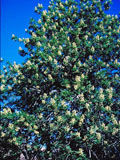
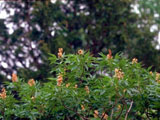
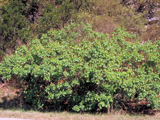
There are two species of the genus Aesculus that answer to the common name Texas Buckeye: Aesculus glabra (Ohio buckeye) and Aesculus glabra var. arguta (Ohio buckeye). You will notice that both are referred to as "Ohio Buckeye," but "Texas Buckeye" is a secondary common name. We are thinking that what you have is probably Aesculus glabra var. arguta; if so, your plant is behaving much nearer the norm than if it is the first plant we mentioned. You can follow the above plant links to our webpage on each tree for more information.
The first of these, Aesculus glabra, can grow to 50 to 75 ft. tall, does well in sun, part shade or shade, and its normal habitat is rich, moist stream banks and bottomlands. This USDA Plant Profile map shows that while it grows in Central Texas, it is not necessarily growing where you are.
The second, Aesculus glabra var. arguta, is a small, multi-trunked tree, 10-25 tall, grows in part shade (2-6 hours of sun daily), likes a wet or moist soil, but can grow in sand, limestone or granite soils. It is better adapted to the hot, dry conditions of Central Texas than the first tree. However, from this USDA Plant Profile, we learn that it populates just about the same places in Texas as the larger buckeye.
From botanybuddy.com we found this short article on Texas Buckeye, from which we extracted this sentence:
"The leaves often develop rust and defoliate before reaching fall color."
Warning: All parts of this tree are poisonous if taken internally. Keep away from livestock; seeds and fruits are attractive to children and are dangerous. May be fatal if eaten!
So, back to your original question. It sounds like your "moderate" amount of shade will qualify for part shade, which the Texas Buckeye likes. It is apparently quite natural for the leaves to drop early. Since this plant is really considered a shrub, as opposed to a tree, it may grow only slowly and not to a much greater height. However, it may also be handicapped by not getting enough moisture, or being in a clay soil. Even if you add water, the clay soil will absorb it, and the roots could suffer from standing in water. If you really want to move it, we suggest you do it now (in early February), while it is still semi-dormant and will not be so liable to transplant shock.
About.com: Landscaping has an excellent instructional on transplanting, and we suggest you read all of it before you make your decision. We would add that you want to avoid "glazed" sides on your hole, which can happen in a clay soil-break up the sides. We would also suggest that you amend the soil that will go back in the soil around the shrub with compost or decomposed granite, or both. These will help drainage in the clay soil, and assist the tiny new rootlets in accessing moisture and nutrition from the soil.
From the Image Gallery

More Transplants Questions
Coreopsis failing to bloom in Sonora CA
August 04, 2009 - My Coreopsis buds form and then die. Very few open. The plants are two and three years old, in a clay type soil. Is it possible they're getting too much water, and that is whats making the buds die ...
view the full question and answer
Propagating yaupons (Ilex vomitoria)
November 30, 2007 - Dear Mr. Smarty,
I enjoy your weekly tips printed in the Austin Statesman.
We live in the Texas hill country where the soil is essentially rock. One of the nice benefits of our yard and the are...
view the full question and answer
Texas Pistachio trees dropping leaves in Austin
June 09, 2010 - I have several Texas Pistachio that are about 13 years old. Despite good rainfall in Travis county this year, they seem to be losing most of their new leaf growth now in early June. Leaves are simpl...
view the full question and answer
Dying blackeyed Susans in new garden in Pennsylvania
August 26, 2008 - Hi Mr. Smarty Plants! I have recently planted black eyed susans in a newly dug garden along with some cone flowers. The other flowers are doing fine but the black eyed susans have all dried up and are...
view the full question and answer
B1 for transplant shock in non-native bamboo?
January 24, 2009 - I am wondering about the details as I wish to transplant some bamboo. I do not know the actual variety, as I have at least 2 types, but will take a cutting to a high end nursery.Some of this is about ...
view the full question and answer
| Support the Wildflower Center by Donating Online or Becoming a Member today. |