Native Plants

Q. Who is Mr. Smarty Plants?
A: There are those who suspect Wildflower Center volunteers are the culpable and capable culprits. Yet, others think staff members play some, albeit small, role. You can torture us with your plant questions, but we will never reveal the Green Guru's secret identity.
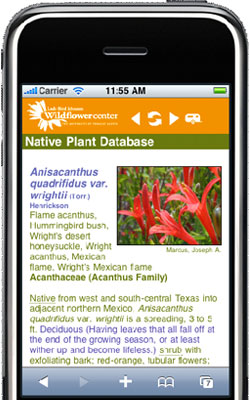
Did you know you can access the Native Plant Information Network with your web-enabled smartphone?

Ask Mr. Smarty Plants
Ask Mr. Smarty Plants is a free service provided by the staff and volunteers at the Lady Bird Johnson Wildflower Center.

rate this answer

Monday - February 07, 2011
From: Cedar Park, TX
Region: Southwest
Topic: Shrubs
Title: Need an evergreen shrub to hide a concrete wall and not attract bees in Cedar Park, TX
Answered by: Jimmy Mills
QUESTION:
I am looking for an evergreen shrub that I can plant in our yard to hide a 3' concrete wall. The area receives full sun during the day, and we would like something that is drought resistant. We also have dogs and small children, so we need something non-toxic and that will hopefully not attract bees. I see a lot of boxwood around, but I would like to change it up a bit with something a bit more decorative. We live in the Austin area. Oh, and if it is fast-growing that would also be a plus. Thanks for your help!ANSWER:
Lets see, we need an evergreen shrub that looks better than a concrete wall, is non toxic, and fast growing. This I think we can do. The part about the bees puts a little sport in the game since many of the plants that Mr. Smarty Plants would normally recommend are flowering plants that are pollinated by bees.
One way to get around this is to focus on wind-pollinated plants which would mostly include ornamental grasses and conifers. A lot of trees are also wind-pollinated, but you need something smaller.
In order to find some possibilities for your plant project, lets go to our Native Plant Database and check it out. After clicking on the link, scroll down to the Combination Search Box, and make the following selections: choose Texas under State, Grass/grass-like under Habit, and Perrenial under Duration. Check Sun under Light requirement, and Dry under Soil moisture. Click the "Submit combination Search" button and you will get a list of 57 native species occurring in Texas that meet these parameters. Clicking on any name on the list will take you to the Native Plant Database page for that plant. There you can learn characteristics of the plant, such as habitat, size, growing conditions, benefits, etc.
Here are a couple of possibilites:
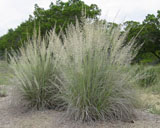
Muhlenbergia lindheimeri (Lindheimer's muhly)
Sorghastrum nutans (Indiangrass)
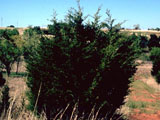
An old standby conifer for hiding things is the Eastern Red Cedar Juniperus virginiana (Eastern red cedar) but it can grow up to 40' tall. For the size wall that you have, you might consider dwarf varieties with a height of 6 - 20' that are described at these links : UConn Plant Database, North Carolina State University, and Waynesboro Nurseries.
When we are asked about toxic plants, we usually go to the databases listed below.
Poisonous Plants of North Carolina
Cornell University Plants Poisonous to Livestock
University of Pennsylvania Poisonous Plants
Canadian Poisonous Plants Information System

More Shrubs Questions
Pruning Citrus Suckers
October 06, 2014 - Mr. Smarty Plants, you are the only person that has "not" insisted that the little balls on Satsuma and lemon trees were clumps of bugs. They are surely what you described in the answer to my previo...
view the full question and answer
Large-scale container garden for New York City
August 17, 2013 - I am a community volunteer in NYC who is trying to help a non-profit set up two large container gardens (about 3 feet high by 4 feet long by 2 or so feet wide). The problem is that they want natives,...
view the full question and answer
Native shrubs that can be pruned to shape in Austin, TX
March 31, 2008 - We have some shrubs in our NE facing front yard in Austin in the Steiner Ranch Area. The shrubs are native, and give good flowers in spring and summer, but are not trimmable and I want something like ...
view the full question and answer
Fuzzy Citrus Fruit on Satsuma and Lemon Trees
September 13, 2014 - A man asked you about fuzzy little small fruit-like balls that looked like tiny lemons. I have huge numbers of these on both my mature Satsuma and lemon tree this year. I get 100's of really great f...
view the full question and answer
Drought tolerant privacy plants for Flagstaff AZ
March 19, 2013 - We need a fast growing drought tolerant tree that will grow in Flagstaff AZ/Parks AZ. Neighbors are hoarders and we want privacy fence to cover the mess. Any help would be greatly appreciated.
view the full question and answer
| Support the Wildflower Center by Donating Online or Becoming a Member today. |