Native Plants

Q. Who is Mr. Smarty Plants?
A: There are those who suspect Wildflower Center volunteers are the culpable and capable culprits. Yet, others think staff members play some, albeit small, role. You can torture us with your plant questions, but we will never reveal the Green Guru's secret identity.

Did you know you can access the Native Plant Information Network with your web-enabled smartphone?

Ask Mr. Smarty Plants
Ask Mr. Smarty Plants is a free service provided by the staff and volunteers at the Lady Bird Johnson Wildflower Center.

rate this answer

Friday - January 21, 2011
From: Merced, CA
Region: California
Topic: Shade Tolerant
Title: Shade trees for horses in Merced, CA
Answered by: Nan Hampton
QUESTION:
I would like to plant some trees to provide shade for horses in the pasture. What native trees are drought resistant (water may be spotty in the summer) yet safe for the animals? I live in the California central valley, and the soil in the pasture is clay. I would put a fence around the trees to protect them.ANSWER:
First, let me tell you which trees are not safe to plant around horses. Avoid all Quercus species (oaks) and Prunus species (plums, peaches, cherries, apricots, etc.). Also, do not plant Acer rubrum (scarlet maple) or any Acer species—see Toxic Plants of Texas. Most pine species are not listed on any toxic plant database, but Pinus ponderosa (Ponderosa pine) does appear on several of the databases below and should not be planted near cattle or horses.
Now, here are some that are safe and will provide shade for them:
Fraxinus dipetala (California ash) is a small deciduous tree (up to 20 feet) with fragrant white flowers. Here are photos and more information.
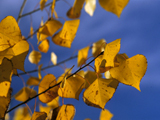
Populus fremontii (Fremont cottonwood) is fast-growing and grows to 60 feet, but it does like moderate water. Female plants produce cotton (the seeds), male plants do not. The 'Nimbus' variety is male. Here are more photos and information.
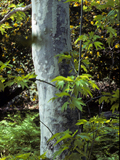
Platanus racemosa (California sycamore) grows fast and can reach 30 to 80 feet, but will need water until established. Here are more photos and information.
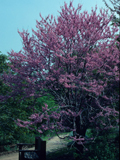
Cercis orbiculata [syn. Cercis occidentalis var. orbiculata] (California redbud) is a small tree (up to 15 feet) with pink blossoms in the spring. Here are more photos and information.
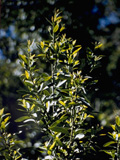
Umbellularia californica (California laurel) is evergreen and a slow-grower to 40 feet. Here are more photos.
Here are databases that you can use to check on toxicity of plants to horses and other animals:
Pennsylvania's Poisonous Plants from the Universtiy of Pennsylvania
Cornell University Plants Poisonous to Livestock
ASPCA's Toxic and Non-Toxic Plant List - Horses
Horse Nutrition: Poisonous Plants from Ohio State University Extension Service
10 Most Poisonous Plants for Horses from Equisearch
Here are photos from our Image Gallery of some of the trees listed above:
More Shade Tolerant Questions
Shade grasses for central Texas
November 16, 2014 - We are new to the area and bought a home this summer that has lots of shade in the very small backyard. The problem is that there was new sod laid in the backyard which now is 50% dead. We do not kno...
view the full question and answer
Native trees for shade in Burbank, CA
May 13, 2009 - I need a few ideas for a non-deciduous (or nearly non-deciduous)tree that grows fast and will provide shade. Shade need not be total. Chinese Elms come to mind but I'm not sure of the growth rate. ...
view the full question and answer
Identifying native sedges
October 14, 2013 - What's the best way to identify a specific sedge ?
view the full question and answer
Leaves turning brown on geum in Mountlake Terrace WA
July 12, 2010 - Assuming a geum is North American . . . mine are turning brown unlike any time before. They get watered occasionally and then dry out. Is there something special I should be doing for geums? They get ...
view the full question and answer
Ground cover for shade from Atlanta GA
May 28, 2012 - I am looking for recommendations for a ground cover. I live in the Atlanta, Georgia area and have a large shady slope on which I would like to use low maintenance/water native ground cover. What wou...
view the full question and answer
| Support the Wildflower Center by Donating Online or Becoming a Member today. |