Native Plants

Q. Who is Mr. Smarty Plants?
A: There are those who suspect Wildflower Center volunteers are the culpable and capable culprits. Yet, others think staff members play some, albeit small, role. You can torture us with your plant questions, but we will never reveal the Green Guru's secret identity.

Did you know you can access the Native Plant Information Network with your web-enabled smartphone?

Ask Mr. Smarty Plants
Ask Mr. Smarty Plants is a free service provided by the staff and volunteers at the Lady Bird Johnson Wildflower Center.

rate this answer

Saturday - November 27, 2010
From: Atlanta, GA
Region: Southeast
Topic: Compost and Mulch, Soils, Erosion Control, Shade Tolerant, Ferns, Grasses or Grass-like, Shrubs
Title: Erosion control on partially shaded slope
Answered by: Guy Thompson
QUESTION:
Mr. Smarty Plants, I live in Atlanta, GA. My house is on a hill, and I am beginning to have erosion at my backyard porch (concrete slab, on the corners especially). The soil is mainly red clay, and it washes away rather vigorously during heavy rains, exposing more of the concrete each time. I am looking for an attractive plant/shrub or grass, as it is our sitting area, that I can plant (partial shade) to prevent this. I do have some moss growing and am not sure if that will help with erosion control. Please help as I am afraid that my slab will crack eventually. Thank you DavidANSWER:
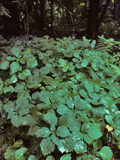
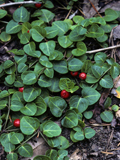
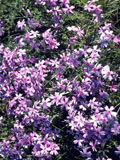
Mr. Smarty Plants can suggest several plants that will form mats and control erosion. But before planting anything it would be desirable to amend your red clay soil with peat moss and good compost to provide nutrients and water-holding capacity. If you prefer low-growing species, you might consider Pachysandra procumbens (Allegheny spurge) or Mitchella repens (Partridgeberry). These native perennials prefer a rather shady site but should do well in your partial shade if kept fairly moist. They will prosper most if shaded during midday. Another possibility is Phlox subulata (Moss phlox), which can tolerate more sun. These and more suggestions are mentioned at the Georgia Native Plant Society web site.
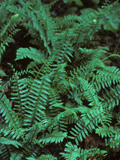
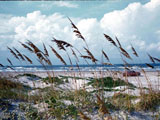
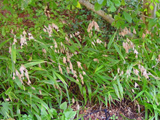
Ferns can prevent erosion too. A good choice for partial shade would be Polystichum acrostichoides (Christmas fern), which, like the other species mentioned above, is evergreen. Grasses can be effective in erosion control. Uniola paniculata (Sea oats) is a common plant on coastal sand dunes but can be grown inland in full or partial sun, producing a flowering spike about three feet high. If you would prefer a somewhat smaller grass, you might consider Chasmanthium latifolium (Inland sea oats). This very attractive grass forms unusual flat seeds on heads rising to about two feet. It does well in shade or partial shade. Both the recommended grasses are perennials, but the vegetative parts die back in winter.
To view more information on the choices suggested, click on the scientific name of the plant in the text above. Attached below are representative images of the recommended species.
From the Image Gallery
More Shade Tolerant Questions
Good evergreen screen and some shade plants for Plano Texas
November 03, 2010 - We live in Plano Texas. We have 15' between our house and our neighbor. We want to plant a divider/screen of something evergreen, about 6-15' (6-8' is better) and narrow, about 2-3' wide between t...
view the full question and answer
Native ornamental grass for part shade in Austin
December 22, 2010 - Hi. I am looking for a fast-growing hardy ornamental grass that will grow in partial shade in south Austin that is not considered invasive. Unfortunately I purchased a few of the Pennisetum setaceum r...
view the full question and answer
Plants for dry shade in West Virginia
April 22, 2010 - I live in Mannington, WV and I am wanting to do some landscaping. The area that I would like to plant in is very dry and gets little to no sunlight. I would like to plant something that will come back...
view the full question and answer
Low maintenance, shade tolerant groundcover for Pacific Northwest
August 09, 2012 - What's a good low maintenance, shade tolerant ground cover for the Pacific Northwest? It needs to have good erosion control, too.
view the full question and answer
Why doesn't my Rusty blackhead bloom?
April 10, 2016 - I have planted Rusty blackhaws the past several years..some bloomed the first year and every year since....and others 3 years old have not bloomed yet...
Do all Rusty blackhaws bloom eventually or ...
view the full question and answer
| Support the Wildflower Center by Donating Online or Becoming a Member today. |