Native Plants

Q. Who is Mr. Smarty Plants?
A: There are those who suspect Wildflower Center volunteers are the culpable and capable culprits. Yet, others think staff members play some, albeit small, role. You can torture us with your plant questions, but we will never reveal the Green Guru's secret identity.

Did you know you can access the Native Plant Information Network with your web-enabled smartphone?

Ask Mr. Smarty Plants
Ask Mr. Smarty Plants is a free service provided by the staff and volunteers at the Lady Bird Johnson Wildflower Center.

rate this answer

Tuesday - October 19, 2010
From: Annapolis, MD
Region: Mid-Atlantic
Topic: Non-Natives
Title: Magnolia and non-native weeping willow competing in Annapolis
Answered by: Barbara Medford
QUESTION:
We planted a sweetbay magnolia next to a Weeping Willow in our yard and did not anticipate the willow would grow so quickly and into the magnolia. We have had the magnolia now for 3 years, and it is close to 13 feet. Is it safe for us to transplant the magnolia to a new location in our yard, and do you have any tips so that we don't lose the beautiful tree?ANSWER:
Yes, take the weeping willow down. Non-native to the United States, Salix x sepulcralis is a hybrid of a Chinese species (Peking willow) and a European species (white willow), and is said to grow in Zones 5 to 8 in the United States. It is weak-wooded, fast-growing and, therefore, short-lived. It has aggressive roots, can lift sidewalks and interfere with sewer lines, often growing on soil surfaces, making a problem with mowing. It is susceptible to a number of pests and diseases, and notorious for littering the ground beneath it. You might check out this University of Florida Extension website on Weeping Willows for more information as well as this Q&A from North Dakota State University Extension on weeping willows.
Given the choice between a lovely native tree like Magnolia virginiana (Sweetbay) and the invasive, non-native weeping willow, we would definitely vote for the magnolia. A 13-ft. tall magnolia would be a challenge to transplant, and you might very well lose it in the process. Then, when the weak, short-lived willow dies, you will have zero trees instead of two. The magnolia will mature to from 12 to 20 ft. in height, and up to 50 ft in the southern part of its range. Since Anne Arundel County is in USDA Hardiness Zone 7a, we feel you could depend on the tree getting taller.
Here are the growing conditions for the Sweetbay Magnolia:
Growing Conditions
Water Use: High
Light Requirement: Part Shade
Soil Moisture: Moist
Soil pH: Acidic (pH<6.8)
CaCO3 Tolerance: None
Soil Description: Rich, moist soils. . Sandy, Sandy Loam, Medium Loam, Clay Loam, Clay, Acid-based
Conditions Comments: Sweetbay is slow-growing and has no serious disease or insect problems. It is good for a small patio or specimen tree. Prune after blooming during the growing season because dormant magnolias do not easily heal.
If you are determined to go ahead with moving the magnolia, here is an article from University of Tennessee on Transplanting Trees. Frankly, we would engage a professional, licensed arborist, with proper equipment and manpower, who could have more success with the move. The same goes with removing the willow, as your first priority is to NOT harm your magnolia.
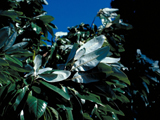
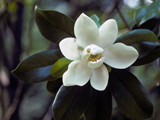
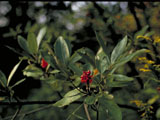
From our Native Plant Image Gallery:
More Non-Natives Questions
Problems with non-native St. Augustine grass in Spring TX
July 09, 2009 - St. Augustine. It's July 6th, 3 weeks ago my grass was green and healthy, today I've got large patches (20' x 3') that are dying. I water my yard 10 mins / day in the morning (5:00 am). It's been...
view the full question and answer
Replacing non-natives and kudzu in Spartanburg SC
July 12, 2009 - I would dearly love to cut down the red tips and leland cypress, as well as the 2 Savannah hollies and 15 ft cleyera which the kudzu has overrun along my property line, get rid of a chunk of lawn and ...
view the full question and answer
Clearing out non-native Himalayan blackberry
January 25, 2009 - Can you recommend a way to clear an area of Himalayan blackberry? We have cut the canes back but wish to eliminate them completely so that we can replant that area with native plants attractive to wil...
view the full question and answer
Seeds of agave attenuata from San Diego CA
April 16, 2012 - After the agave attenuata bloom dried up there are seeds like thing hanging on the foxtail; do I leave it until it dies or do I chop that down. Are those seeds for propagation. The leaves of the plan...
view the full question and answer
How much water does St. Augustine require in Junction, TX?
February 12, 2012 - Can you point me towards a concrete study on how much water St Augustine requires to survive? Much appreciated - Native American Seed
view the full question and answer
| Support the Wildflower Center by Donating Online or Becoming a Member today. |