Native Plants

Q. Who is Mr. Smarty Plants?
A: There are those who suspect Wildflower Center volunteers are the culpable and capable culprits. Yet, others think staff members play some, albeit small, role. You can torture us with your plant questions, but we will never reveal the Green Guru's secret identity.

Did you know you can access the Native Plant Information Network with your web-enabled smartphone?

Ask Mr. Smarty Plants
Ask Mr. Smarty Plants is a free service provided by the staff and volunteers at the Lady Bird Johnson Wildflower Center.

rate this answer

Tuesday - September 21, 2010
From: Austin, TX
Region: Southwest
Topic: Grasses or Grass-like
Title: Problems with Mexican feathergrass in Austin
Answered by: Barbara Medford
QUESTION:
All of my mexican feathergrass plants have died or gone dormant, laying down flat for the most part. Any idea what's going on with them?ANSWER:
Without knowing exactly under what conditions your Nassella tenuissima (Mexican feathergrass) is growing, it's hard to say. Here is what our Native Plant Database page on this plant has to say:
"Growing Conditions
Water Use: Low
Light Requirement: Sun , Part Shade
Soil Moisture: Moist , Dry
Soil Description: Well-drained, acid or calcareous sands, loams, or clays.
Conditions Comments: Requires good drainage and cant take excessive moisture. Should not be watered heavily more than once a week. Goes dormant during drought and in winter. May rot under heavy mulch. Grows well in containers."
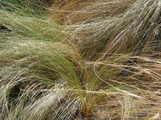
You will note that it goes dormant during drought and in winter. Until it finally started raining last week, this summer has been very dry. How long have they been planted? If they are recently planted, perhaps they were planted when it was too hot, or do not have good drainage in their beds. If water stands for a while on the ground when you water, it is a sign that clay soil underneath is not draining well, and this plant cannot tolerate water standing on its roots. If the grasses are in a sprinkler system area, and getting more than the once a week watering, that could be a problem. It also doesn't like heavy mulch. We would suggest that you trim down the grasses to about 6", pretending that it is winter. This will take some stress off the plant, so it is not trying to get water up to higher portions of the plant. Then, only water them once a week, and not that if there has been regular rain. Let the water dribble into the plant area from a hose, and don't water them from an overhead sprinkler system if you can avoid it. Notice in the pictures below that the feathergrasses have various positions of "standing up," with some portions of the plant on the ground and/or turning brown.
From our Native Plant Image Gallery:


More Grasses or Grass-like Questions
Native Desert Willow and bunchgrass for Lubbock TX
July 29, 2013 - We live in Lubbock and have decided to try to make our front yard as native as possible. It has been a very difficult process finding native species locally (even the local Aggie nursery sells a lot ...
view the full question and answer
Native lawn solution for Southeast Texas from Missouri City TX
May 05, 2012 - I noticed the native lawn article regarding Habiturf states it is for "North, West and Central Texas". What is the recommended native lawn solution for Southeast Texas/Gulf Coast (Houston/Galveston...
view the full question and answer
Plants for a sunny, dry slope in NY
March 01, 2010 - Looking for plants, native to area, that are quick growing to a height of approximately 6" to 12" for a steep slope comprised of shale in a sunny location.
view the full question and answer
Muhlenbergia dumosa safe for horses from Austin
May 13, 2014 - Is Muhlenbergia dumosa safe for horses? Will horses eat it? I have a client who has a mini-horse who visits her property on occasion, and I want to ensure that what I plant is both safe for the hors...
view the full question and answer
Sun requirement for native turf grasses
May 25, 2011 - What are the sun requirements needed for the native grass seed mix you recently released? I have a pretty well shaded back yard. Will this stuff grow well in this condition?
view the full question and answer
| Support the Wildflower Center by Donating Online or Becoming a Member today. |