Native Plants

Q. Who is Mr. Smarty Plants?
A: There are those who suspect Wildflower Center volunteers are the culpable and capable culprits. Yet, others think staff members play some, albeit small, role. You can torture us with your plant questions, but we will never reveal the Green Guru's secret identity.

Did you know you can access the Native Plant Information Network with your web-enabled smartphone?

Ask Mr. Smarty Plants
Ask Mr. Smarty Plants is a free service provided by the staff and volunteers at the Lady Bird Johnson Wildflower Center.

rate this answer

Saturday - June 05, 2010
From: Richardson, TX
Region: Southwest
Topic: Diseases and Disorders, Herbs/Forbs
Title: Problems with giant coneflower in Richardson TX
Answered by: Barbara Medford
QUESTION:
Dear Mr Smarty Plants- I have had a giant coneflower in my garden for 2 years now. This year it came up like it always had..got lots of leaves and then withered..turned brown and died. It got plenty of sun and I have no idea why it just up and died. Needless to say I am heart broken. Can these coneflowers survive Richardson/Dallas winters? Is there something else I should know about them perhaps?ANSWER:
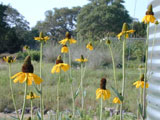
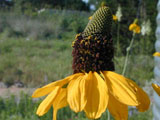
We recently had a question about a plant that had been thriving simply dying overnight. A little discussion and detective work gave us the idea this was animal damage, as in cats or dogs using it for a bathroom. If you know you have cats and/or dogs loose in your neighborhood, you could at least consider that possibility. Depending on where you are, it could be animals eating the roots, although it would not have died so abruptly. If your Rudbeckia maxima (great coneflower) came up in the Spring, it would seem it can easily survive your winters, as just about the whole state had much colder weather, with sudden freezes and prolonged periods of freezing this year.
If you saw any kind of insect damage, or suspected an accidental spraying of herbicide, perhaps drifting from another location, that could explain it. However, most native plants can withstand a few local insects. Frankly, in sudden and unexplained plant deaths like this, we seldom know the truth about what happened. If you feel that the animal damage theory is correct, you could try spreading an aromatic shredded hardwood bark mulch over the area. It is too late in the season to plant a replacement, but if you spread the mulch and then replant in the Fall, the animals might have lost interest in your area and gone somewhere else.
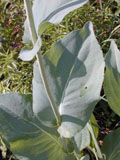
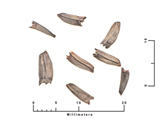
From our Native Plant Image Gallery:
More Diseases and Disorders Questions
Problems with Green Cloud purple sage in Buda TX
May 30, 2009 - I planted the "Green Cloud" variety of purple sage about 3 years ago. Yesterday, I noticed yellowish dots on the underside of the leaves of some plants. Is this harmful? The plants seem to be ok ...
view the full question and answer
Effect of unusual wet weather on desert willows
July 23, 2007 - I live in North Central Texas and have 3 beautiful Desert willow trees that are usually in full bloom. I've kept them pruned to form a nice full tree shape but now they are losing leaves and looking ...
view the full question and answer
Cool, wet summer effect on evergreen sumac
August 28, 2007 - Hi Mr. Smarty Plants,
I have 3 evergreen sumac bushes that I planted as a screen between my house and my neighbors two years ago. They are located in a part of our yard that receives a lot of runof...
view the full question and answer
Need to identify leaf extensions on the leaves of an elm sapling in Houston, Tx.
May 22, 2013 - I have an elm sapling which grows strange leave extensions on its leaves. Can I send you a picture? Tree looks healthy
view the full question and answer
Redbud leaves turning yellow in mid-summer
July 13, 2012 - The leaves on our redbud trees are turning yellow. The yellow leaves are pale with no other spots and no dark veins. I don't know for sure which variety of redbud they are or how old they are (more t...
view the full question and answer
| Support the Wildflower Center by Donating Online or Becoming a Member today. |