Native Plants
Q. Who is Mr. Smarty Plants?
A: There are those who suspect Wildflower Center volunteers are the culpable and capable culprits. Yet, others think staff members play some, albeit small, role. You can torture us with your plant questions, but we will never reveal the Green Guru's secret identity.
Did you know you can access the Native Plant Information Network with your web-enabled smartphone?

Ask Mr. Smarty Plants
Ask Mr. Smarty Plants is a free service provided by the staff and volunteers at the Lady Bird Johnson Wildflower Center.

rate this answer

Friday - May 28, 2010
From: Wichita, KS
Region: Midwest
Topic: Grasses or Grass-like
Title: Advice on grasses under walnut trees
Answered by: Nan Hampton
QUESTION:
Little advice on grasses: I am prepared to plant zoysia under two walnut trees. Forgot about juglone-is this a good idea?ANSWER:
All members of the Family Juglandaceae (Walnut Family), including pecan, butternut and hickory trees as well walnuts, produce and release a chemical called juglone to defend their growing space against encroachment by other plants. The amount or strength of the juglone released varies among the different species of the family. I don't know which walnut trees you have, Juglans nigra (black walnut tree) or Juglans microcarpa (little walnut), but black walnut is reported to have the most, or at least, the most effective juglone. With this defense mechanism, called allelopathy, the tree adversely affects many other (but not all) plants. Juglone can be found in all parts of the black walnut tree. If the roots of another plant come within 1/2 inch of the walnuts roots, they can absorb the juglone and sicken and die. Also, walnut leaf litter and walnut fruit on the ground leach juglone into the soil. Virginia Extension Service has an excellent discussion of the black walnut and its allelopathic effects. Additionally, the article lists common plants that are affected by the juglone of the walnut. There is also a list of plants that will grow near the black walnut. There are other lists of plants affected by and/or tolerant of juglone (e.g., Cornell Cooperative Extension and University of Wisconsin Extension) but all of them are rather short on any grasses on the list.
A search for "zoysia" and "walnut or juglone" gave contradictory results with some evidence that juglone affected the grass and other evidence suggesting it was as much the shade as the juglone that was the culprit. This is sort of all beside the point, however, because Mr. Smarty Plants wouldn't recommend zoysia in the first place since it is native to Asia and Australasia and what we are all about here at the Wildflower Center is "to increase the sustainable use and conservation of native wildflowers, plants and landscapes"
I can, however, offer some substitutes. There are no native turf grasses that do well in the shade, but there are a few possibilities for ground covers that are shade-loving and juglone resistant. Here are a few:
Chasmanthium latifolium (Inland sea oats) is an attractive clumping grass that loves the shade and isn't affected by juglone. (This is a personal observation since I have a large population of inland sea oats growing under my black walnut tree and it has grown there for several years). Here is more information.
Sedges are resistant to the effects of juglone and they grow well in the shade. Carex blanda (eastern woodland sedge) is native to Kansas and would make a good ground cover. Here is more information and photos of Carex blanda.
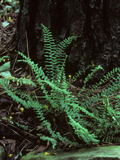
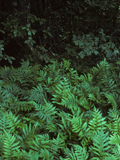
Ferns are also resistant to juglone and grow well in the shade. Here are some suggestions native to Kansas:
Asplenium platyneuron (ebony spleenwort) and here is more information.
Onoclea sensibilis (sensitive fern) and here is more information.
More Grasses or Grass-like Questions
Drought-resistant plants for Paradise, California
January 23, 2009 - We are moving to a new home in Paradise, CA. What drought resistant plants do well in Paradise ?
Thank you !!
view the full question and answer
Indiangrass by seed or plugs in Greenville SC
October 18, 2009 - Mr Smarty Plants, is it better to establish Indiangrass by plugs or seed? Seems you would get much quicker coverage by seed, tending to choke out "strangers".
I'm establishing a small native mea...
view the full question and answer
Plants to stabilize a bank in VT
April 10, 2012 - I am looking for suggestion on what plants might best be suited for aiding in the stabilization of a very steep bank above Lake Champlain.
view the full question and answer
Need native plants to place in chicken coop in Charolette, NC
September 20, 2014 - Hi, I live near Charlotte, NC. I'm looking for native plants that I can plant in my chicken coop that will produce food for the chickens. If they also produced some delicious food for me, I wouldn't...
view the full question and answer
Native plants for landscaping backyard in Central Texas
January 02, 2008 - We are starting from scratch in our backyard (approx. 200'x60')in Central Texas (Cedar Park). The yard faces West. What do you recommend for plants, trees, shrubs and grass that are native and will ...
view the full question and answer
| Support the Wildflower Center by Donating Online or Becoming a Member today. |