Native Plants

Q. Who is Mr. Smarty Plants?
A: There are those who suspect Wildflower Center volunteers are the culpable and capable culprits. Yet, others think staff members play some, albeit small, role. You can torture us with your plant questions, but we will never reveal the Green Guru's secret identity.

Did you know you can access the Native Plant Information Network with your web-enabled smartphone?

Ask Mr. Smarty Plants
Ask Mr. Smarty Plants is a free service provided by the staff and volunteers at the Lady Bird Johnson Wildflower Center.

rate this answer

Wednesday - May 19, 2010
From: Austin, TX
Region: Southwest
Topic: Privacy Screening
Title: Plants for privacy shield in Austin
Answered by: Barbara Medford
QUESTION:
We are looking for a tall hedge on the lot line between us and our neighbors. Thinking Prunus caroliniana (Carolina laurelcherry) would be a good choice. Question: how close should we plant them together to get both good privacy and healthy growth? Also thinking about tall Italian Blue Cypress. Same question: How close can we plant them together?ANSWER:
Starting with the last question first, the Lady Bird Johnson Wildflower Center is dedicated to the use, protection and propagation of plants native not only to North Amerca but to the area in which the plants are being grown. Cupressus sempervirens, Italian Blue Cypress, is native to Africa, Temperate Asia (including, of course, Cyprus) and Greece. Here is an extract from a USDA Forest Service website Cupressus Sempervirens:
"Italian Cypress is often used for framing, as a strong accent around large buildings, or in the formal landscape but does not lend itself well to many home landscapes. It quickly grows much too tall for most residential landscapes, looking much like a green telephone pole." The article also says that if they are planted 3 ft. apart, they make a dense screen.
Going back to a native plant, Prunus caroliniana (Carolina laurelcherry), we have another quotation, this time from a previous Mr. Smarty Plants answer:
"Although a little west of its eastern limit, Prunus caroliniana (Carolina laurelcherry) would be a good choice for a small evergreen tree in your landscape. You might also consider Ilex vomitoria (yaupon)."
As a general rule, the diameter of a shrub is about equal to the height of the shrub. In other words, if you have a six-foot tall shrub, it should spread about three feet in every direction for a total of 6 feet in diameter. So, if you want a screen effect, a distance of 5 to 6 ft., trunk to trunk would allow the outer tips of the shrubs to mesh. You can plant them closer if you wish, but they would begin to shade each other, and the interiors of the plants would become scraggly and less of a screen.
Pictures of Cupressus sempervirens from Google
From our Native Plant Image Gallery:
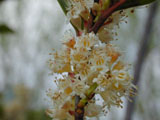
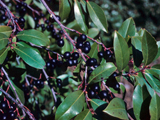
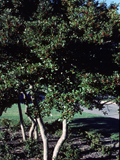
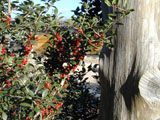
More Privacy Screening Questions
Evergreen screening tree for Wichita Falls TX
November 25, 2015 - Recommendations for a screen plant. Dry. full sun. 20 to 30 ft.high. evergreen. Wichita Falls, TX location.
view the full question and answer
mixed species privacy hedge in Central Texas
March 24, 2016 - I need to plant a privacy hedge along a fence line. I am in east Austin, blackland prairie soil. The soil is rich, usually at least moist but not soggy, and I find lots of worms when I dig. The fen...
view the full question and answer
Fast-growing hedge for North Carolina.
February 17, 2009 - I am looking for a fast-grownig evergreen hedge that can be kept no taller than 6 feet. It will be grown in partal sun facing north
view the full question and answer
Screen Tree for Lockhart, TX.
March 30, 2015 - What is a good screening tree for a ranch in the Lockhart area that won't get much water.
view the full question and answer
Privacy screen in Kansas City, MO
April 04, 2012 - Hello, I am located in Kansas City, MO and am looking for a wall/screen plant. Last year I used a wall of sunflowers and loved them, however I want something more hardy and something I don't have to ...
view the full question and answer
| Support the Wildflower Center by Donating Online or Becoming a Member today. |