Native Plants
Q. Who is Mr. Smarty Plants?
A: There are those who suspect Wildflower Center volunteers are the culpable and capable culprits. Yet, others think staff members play some, albeit small, role. You can torture us with your plant questions, but we will never reveal the Green Guru's secret identity.
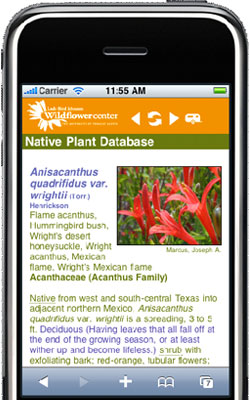
Did you know you can access the Native Plant Information Network with your web-enabled smartphone?

Ask Mr. Smarty Plants
Ask Mr. Smarty Plants is a free service provided by the staff and volunteers at the Lady Bird Johnson Wildflower Center.

rate this answer

Thursday - April 22, 2010
From: Lansford, PA
Region: Mid-Atlantic
Topic: Poisonous Plants
Title: Recommended plants for horse farm in Lansford PA
Answered by: Barbara Medford
QUESTION:
Recently started a small horse farm in northeast Pennsylvania just east of the Pocono Mountain plateau. Located in a foggy valley adjacent to a lake. Snowy, cold winters; wet springs; dry summers; nice autumns. Lots of water runoff in fields from mountains. Farm is mostly sloped; but water is about 6 inches below ground all year due to multiple natural springs on farm. What types of fruit, shade, evergreen trees; shrubs; flowers are compatible and of course non-toxic to horses?ANSWER:
This is a pretty complex question and we will have to break it down into smaller bites. Since we are not onsite (and probably couldn't handle it if we were) we have no idea what should go where, we don't know where you have sun and where you have shade, and what sort of future plans you have for landscaping. Let's start with the "don'ts." Since the Lady Bird Johnson Wildflower Center is dedicated to the use, protection and propagation of plants native not only to North America but to the area in which the plants are being grown, we are not going to be much help in the choices of fruits to grow. Most fruits are non-native to North America and so hybridized that their parentage is unidentifiable. There are a few varieties of Prunus, wild plums, that are native, but they have many poisonous parts, and are especially dangerous for livestock. Don't plant those.
We will warn you of being careful of the drainage in your soil, considering the underground springs. Many plants will not withstand constant wet feet, and will need to be planted so that their roots can get oxygen and nutrients from the soil. Before you turn your horses out on the property, you need to attempt to identify what is there and make sure there are no plants that the horses could browse that would be harmful to them, besides the wild plums. Over time, we have accumulated a list of websites that identify plants poisonous to animals (including people, of course.)
We always recommend, when a property like this is purchased, that you first look at the existing plants.Try to utilize the plants that are already there and thriving, hopefully all native. To try to landscape an entire property at once would be cost-prohibitive; it would appear that the environment you described should have created a beautiful natural landscape. There are probably many lovely plants native to the area, and some escaped non-natives. Now, how to find additional plants for your property. To begin with trees, go to our Recommended Species section, click on Pennsylvania on the map. Then, on the list on the right side of the page, check that you want trees (under General Appearance), check the Light Requirements, and soil moisture, which will obviously be "wet" for you. When you click on Narrow Your Search, you will get a selection of trees that fit all your attributes and grow natively in Pennsylvania. Do the same with "herbs" (herbaceous blooming plants), and "shrub." For "grasses," you will need to go to our Native Plant Database, which is a ongoing work in progress, and does not yet have lists of the grasses from every state; and you will use the same procedures under Combination Search.
Finally, poisonous plants. We have a list of links to poisonous plant databases below. When you have chosen a plant, search each database. It is easier if you use the scientific name, but most of these lists accept common names, too.
Poisonous Plants in North America:
Toxic and Non-Toxic Plant List—Horses Poisonous Plants of North Carolina Cornell University Plants Poisonous to Livestock University of Pennsylvania Poisonous Plants Canadian Poisonous Plants Information System Horse Nutrition: Poisonous Plants from Ohio State University Extension Service Toxic Plants from the University of California-Davis 10 Most Poisonous Plants for Horses from Equisearch PullmanUSA - plants poisonous to both cats and dogs
More Poisonous Plants Questions
Is Fern-like Plant with White Flower Poison Hemlock?
May 06, 2014 - I have a fern-like plant which produces white flowers that uncurl from the stem as the plant starts to grow. Is this poison hemlock?
view the full question and answer
Is wild foxglove poisonous to dogs from Liberty TX
May 05, 2012 - Is penstemon cobaea (wild foxglove)poisonous to pets, specifically dogs. I was thinking about adding this to my native Texan wild flower section of my backyard.
view the full question and answer
Information on Royal Empress tree
May 01, 2008 - Would like to have some information on the royal empress tree; it is a non-native tree.
view the full question and answer
Smarty Plants on Poisonous Plants
October 27, 2004 - Hi Mr. Smarty Plants,
I wonder who among the wonderful staff at the Wildflower Center can answer this. I occasionally get requests for information on toxic or irritating plants. Beyond the obvious ...
view the full question and answer
Is Savannah Holly poisonous to burn in Hanahan, SC.?
August 20, 2011 - Can you please tell me if the wood from a savannah holly bush is poisonous to burn?
view the full question and answer
| Support the Wildflower Center by Donating Online or Becoming a Member today. |