Native Plants
Q. Who is Mr. Smarty Plants?
A: There are those who suspect Wildflower Center volunteers are the culpable and capable culprits. Yet, others think staff members play some, albeit small, role. You can torture us with your plant questions, but we will never reveal the Green Guru's secret identity.
Did you know you can access the Native Plant Information Network with your web-enabled smartphone?

Ask Mr. Smarty Plants
Ask Mr. Smarty Plants is a free service provided by the staff and volunteers at the Lady Bird Johnson Wildflower Center.

rate this answer

Wednesday - February 24, 2010
From: Oceanside, CA
Region: California
Topic: Invasive Plants
Title: Native plants to go between patio stones in Oceanside CA
Answered by: Barbara Medford
QUESTION:
Hello Mr. Smarty Plants! I live in Oceanside CA about 5 mi from the coast and have an about 20' sq private patio with "issues". Patio has with flagstones, one side all sun all day, middle area partial shade all day (shade fabric covers area), one side sun in late PM only. I am having trouble finding a low height no mowing ground cover for between the flagstones, that will "fit the bill" for all the patio. It needs to be drought resistant because of the clime & my tendency to forget to water daily for 15 minutes (and the smallness of the area - irrigation or drip systems are not workable - manual only). Part of the area has Korean Grass (doing wonderfully), part seems to like baby tears ground cover and part just likes weeds! Suggestions?ANSWER:
For openers, the plants you are using now are not native to North America. Since our expertise only extends to plants native not only to North America but to the area in which the plants are being grown, we cannot recommend either. Urticaceae solerolia, Baby's Tears, is native to the Northern Meditteranean, around Italy. It is often grown indoors as a houseplant, prefers shade and moderate moisture. It is considered a common weed in many places, and can be very invasive, almost impossible to control. We don't like invasives, either. Zoysia japonica, Korean lawn grass, was introduced into the U.S. in 1895 from the Manchurian Province of China.
Finding a native groundcover that will suit your purposes and the varying environments for plants in your patio is difficult. Las Pilitas Nursery, which specializes in California native plants, has a location in San Diego County, where you are, and could probably help you more than we could. We looked at their page on groundcovers under 1' tall, but most of them seemed too tall to work in your situation. However, if you contact them or visit, they can probably find something that works for you.
We went to our Native Plant Database, looking at some of the very low-growing plants we have had experience with before that could work in your situation. A few of these were on the Las Pilitas list, and all are native to California. We also checked each of our selections with the USDA Plant Profile on that plant to determine if it grew in or near San Diego County. None of the five fit all your specifications. You are doing the right thing to keep the spaces between your flagstones permeable; that is, permitting water to go down into the soil for tree roots that may be trying to survive, but you could find that putting pea gravel or a good quality shredded hardwood mulch into those spaces will accomplish the same purposes without the maintenance.
Low groundcovers for patio in San Diego Co., California:
Symphoricarpos mollis (creeping snowberry) - part sun to shade, low water use
Phyla nodiflora (turkey tangle fogfruit) - semi-evergreen, perennial, sun or part shade
Fragaria vesca (woodland strawberry) - part shade, shade
Heuchera rubescens (pink alumroot) - perennial, part shade
Heuchera rubescens var. versicolor (pink alumroot) - perennial, shade Pictures from Google
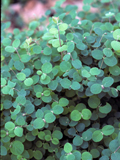
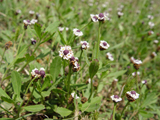
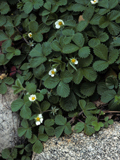
From our Native Plant Image Gallery:

More Invasive Plants Questions
Invasive, non-native Siberian peashrub for waller TX
February 02, 2012 - Good Morning Mr. Smarty Plants! I am trying to find out if the Siberian Pea Shrub is a good plant for Southeast Texas or if it is considered an invasive no no. It seems to have many qualities for wild...
view the full question and answer
Plants for under pine trees in Colorado Springs CO
April 23, 2011 - What can I plant under pine trees in Colorado that will grow every year? Would like ground cover; tried bishop weed.
view the full question and answer
Controlling Devil's Bit in Collin County, TX
June 05, 2015 - I live in Collin County and our pasture has a growing section of Devils Bit taking over everything. I've been using 2,4-D on it with some success.
What is the best method of control for this ...
view the full question and answer
Pruning of Grape Kool Aid Plant in California
August 03, 2008 - I have a Grape Kool Aid plant and was told it would grow to 6 or 7 feet tall, but it is well over that and I need to know if I can prune it and if so how?
view the full question and answer
Need care instructions for Cardiosperma halicacabum in Little Rock, AR>
May 11, 2012 - I'd like to find out how to cultivate & care for a balloon vine/heart seed vine/love in a puff vine which I found growing wild in my yard (in Little Rock, Arkansas). There seems to be very little in...
view the full question and answer
| Support the Wildflower Center by Donating Online or Becoming a Member today. |