Native Plants

Q. Who is Mr. Smarty Plants?
A: There are those who suspect Wildflower Center volunteers are the culpable and capable culprits. Yet, others think staff members play some, albeit small, role. You can torture us with your plant questions, but we will never reveal the Green Guru's secret identity.

Did you know you can access the Native Plant Information Network with your web-enabled smartphone?

Ask Mr. Smarty Plants
Ask Mr. Smarty Plants is a free service provided by the staff and volunteers at the Lady Bird Johnson Wildflower Center.

rate this answer

Friday - March 05, 2010
From: Austin, TX
Region: Southwest
Topic: Seasonal Tasks, Cacti and Succulents
Title: What to do about cold damage to spineless prickly pear?
Answered by: Jimmy Mills
QUESTION:
In Austin, Texas our 'spineless' prickly pear cactus is about 6' wide by 4' tall. In the last severe freeze, the top half flattened out and has remained that way. Should I cut the flattened pads off, and if so, should I paint the cuts so they won't get waterlogged when it rains or otherwise decay? Or what should I do with the cactus? Thank you.ANSWER:
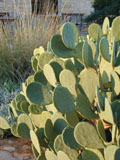
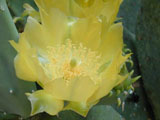
The spineless prickly pear in our area is Opuntia ellisiana (tigertongue) , and is generally considered to be rather cold hardy, however this winter has done a number on them all over the area. A 4' by 6' plant makes a handsome specimen, and is worth the effort it takes to save it.
The plant may slough off the more severely damaged pads on its own, but Mr. Smarty Plants recommends being more pro-active and removing the flattened pads now. Cut the pads at the point of attachment, and the plant will produce callus tissue at the site that will protect against invasion by microbes, so wound painting is not necessary and is actually counterproductive. You may wish to remove up to one third of the height of the plant, but keep in mind the overall shape you want to achieve. The plant will produce new pads in the spring growing season.
Just because the cactus is "spineless", don't be lulled into thinking that the plant is harmless. Its "second line of defense" is perhaps more insidious that the spines, since they are not as obvious. These are the small hair-like spines called glochids that occur on the aereoles. They are characteristic of the genus Opuntia, and O. ellisiana certainly has its share.
The glochids have small barbs so that when they enter the skin, they are difficult to remove. The best defense is prevention; when handling the cactus pads, wear thick gloves. Be aware that the glochids do attach to gloves and clothing, so be careful handling them after the pruning.
If you want more prickly pear plants, use the pads that you cut off to propagate more.
From the Image Gallery
More Cacti and Succulents Questions
Dealing with beetles feeding on cholla cactus
June 20, 2010 - Hi Mr. Smarty Pants,
I bought a Cylindropuntia imbricata from the Wildflower center and it was growing like crazy. I recently noticed a lot of beetles feeding on it. Some are black and some are gra...
view the full question and answer
Yuccas and prickly pears for Warren MI
February 11, 2009 - What type of yuccas and prickly pears will survive in the Detroit, Michigan area? Also, can I grow Santa Rita prickly pear in a pot?
view the full question and answer
Wholesale dry yucca trunks and branches from California
January 29, 2012 - Where can I buy wholesale dry yucca trunks and branches? I have spent the last hour looking for them and can only find nurseries and decorative branches.
view the full question and answer
Damage to Agave in New Braunfels, TX
August 21, 2008 - In a flower box, I have an Agave on which the leaves have been damaged. It looks as if a deer rubbed his antlers on it. Is there any animal in south central Texas that would try to eat an agave?
view the full question and answer
Will a cut back yucca grow back in Lockbourne OH?
October 28, 2009 - I live in Ohio and recently I cut back all my plants to prepare for winter. I am wondering if my Yuccas will grow back. I cut them to ground level so only a little bit of the leaf is showing. I was...
view the full question and answer
| Support the Wildflower Center by Donating Online or Becoming a Member today. |