Native Plants

Q. Who is Mr. Smarty Plants?
A: There are those who suspect Wildflower Center volunteers are the culpable and capable culprits. Yet, others think staff members play some, albeit small, role. You can torture us with your plant questions, but we will never reveal the Green Guru's secret identity.

Did you know you can access the Native Plant Information Network with your web-enabled smartphone?

Ask Mr. Smarty Plants
Ask Mr. Smarty Plants is a free service provided by the staff and volunteers at the Lady Bird Johnson Wildflower Center.

rate this answer

Sunday - January 03, 2010
From: Hico, TX
Region: Southwest
Topic: Diseases and Disorders
Title: Fungus on spineless prickly pear in Hico TX
Answered by: Barbara Medford
QUESTION:
Is there anything I can do to save my spineless prickly pear planted 3 yrs ago in rock garden. Pods had grayish-white fungus? on the pods and I noticed a few green colored bugs on them. Bugs are gone- but pods are drooping and falling off,like they have rotted and are mushy. There are several other cactus nearby and need help to save others? thanksANSWER:
This is almost surely a moisture-related problem. Even in a rock garden, your Opuntia ellisiana (tigertongue) is probably being subjected to more watering than it can tolerate, and perhaps without sufficient drainage. You need to remember that these are desert plants, accustomed by millennia of experience to growing in fast-draining sand (when there was any rain water to drain) and surviving. They are succulents, holding moisture inside their structure, but moisture collecting around their bases or soil that is too moist will encourage fungus. To protect your other plants, you need first to remove the pad(s) that are appearing rotted and mushy; in fact, it might be necessary to remove the whole plant. This will help prevent the spreading of the fungus to other cacti near it.
You next need to address the amount of water that is being applied to the garden, either by rain or artificial irrigation. You say you planted your rock garden three years ago; this may be the first time since it was planted that it has received very much rain. Since Central Texas is unexpectedly getting some rain this Fall and early Winter, it's possible that poor drainage is causing that water to collect. Under no circumstances should your Opuntia be receiving supplemental watering. At this point, if the drainage in your rock garden is insufficient to protect the roots of the cacti, there is not a lot you can do about it. If and when plants have to be removed because of the problem, you can replace the soil with a more sandy mixture specifically for the growth of cacti and other succulents before you re-plant. And don't fertilize. These are native plants that can get along just fine with the materials in the soil where they live. Fertilizing will only encourage fresh growth, which is going to be more prone to disease.
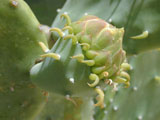
From our Native Plant Image Gallery:


More Diseases and Disorders Questions
Mountain laurel (Sophora secundiflora) refuses to bloom
March 07, 2008 - We have a Texas Mountain Laurel that gets full sunlight, but does not bloom. It is 4-5 ft tall & 3-4 ft wide & healthy. Is there anything we can do to make it bloom next year?
view the full question and answer
Fasciation in Houston.
March 29, 2008 - I live in Houston and have had a rather large flower garden for many years. Most of the flowers are just gorgeous but over the last two or three years I have noticed that occasionally some of the flo...
view the full question and answer
Leaves wrinkling on Tecoma stans from San Antonio TX
August 16, 2013 - My two year old esperanza (planted in the ground) froze back last winter, came back from the roots & has been doing well all summer. Recently one branch has leaves that are nice & green but very wrin...
view the full question and answer
Juniper as host of cedar-apple rust
July 17, 2007 - Thanks for the helpful advice on the Eastern Red Cedar. I was wondering if you could ease my mind about a potential problem. I have read up on some of the native plants in my area in a very good book ...
view the full question and answer
Burning sulfur over coals in the home for insect control.
July 18, 2008 - Is burning sulfur(over hot coals) in your home a safe way of getting rid of ants and insects?
view the full question and answer
| Support the Wildflower Center by Donating Online or Becoming a Member today. |