Native Plants
Q. Who is Mr. Smarty Plants?
A: There are those who suspect Wildflower Center volunteers are the culpable and capable culprits. Yet, others think staff members play some, albeit small, role. You can torture us with your plant questions, but we will never reveal the Green Guru's secret identity.
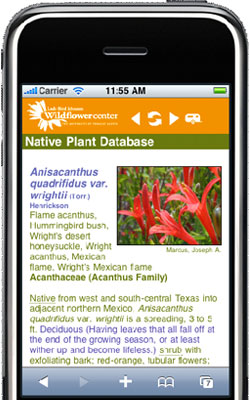
Did you know you can access the Native Plant Information Network with your web-enabled smartphone?

Ask Mr. Smarty Plants
Ask Mr. Smarty Plants is a free service provided by the staff and volunteers at the Lady Bird Johnson Wildflower Center.

rate this answer

Monday - December 07, 2009
From: Austin, TX
Region: Southwest
Topic: Invasive Plants
Title: Eliminating bamboo in Austin
Answered by: Barbara Medford
QUESTION:
Everyone should be warned about bamboo and how invasive it is. My neighbor planted it in his back yard and it's now taking over my back yard and all the surrounding yards. He installed a barrier but the bamboo has gone under the 18-inch barrier and is spreading like wildfire. It is all over my compost bin. How can we get rid of it permanently without using chemicals?ANSWER:
We absolutely agree that every gardener should know that Phyllostachys aurea or Bamboo is one of the most invasive, difficult to destroy plants around. It grows fast, spreads by underground rhizomes and just keeps on coming. Landowners who regard it as a cheap quick privacy shield should think again. Once you have planted it, getting rid of it is going to be a struggle. And pity the poor neighbors who did not choose to have it and can't prevent it encroaching on their property. The most effective method really involves enlisting everyone in the neighborhood in the project of elimination. One stand left will still be busily sending out messengers to open land anywhere around. If you cannot get everyone to sign onto the job, then you will just have to fight a constant delaying action.
Here is a good article from eHow.com on How to Get Rid of Bamboo. The main principle is to starve out the plant. No plant, no matter how big or tenacious, can survive forever without leaves above the ground producing food for the roots and maintenance of the plant. Again, the problem with that is the existence of those underground tubers or rhizomes that have a surplus inventory of nutrients for the mother plant, just in case of emergency. With persistence, however, even they can be exhausted and starved out. You asked for a non-chemical plan, and that is about it. Just keep mowing, pulling and disposing of every sprout of it you can reach. Rhizomes can sometimes be dug up, as the article mentions, but even a small piece of it left in the ground will generate more stalks of bamboo!
If you finally cave and decide to go on the chemical route, do not spray, because that will probably never get to the rhizomes, but will certainly kill some of your own plants that you are trying to preserve. Note Step 4 in the referenced article, saying to immediately pour the herbicide down into the cut stalk. Hopefully, this will spread down into the roots and even to the rhizomes.
And did we mention how much the Lady Bird Johnson Wildflower Center dislikes the use of non-native plants, such as bamboo? It is the Poster Plant for non-natives that will cause far more trouble than they are worth. Choosing natives and researching their usability and adaptation in the local environment is far less trouble and grief than disposing of the unwanted.
More Invasive Plants Questions
Creeping buttercups in juniper in McKeesport PA
May 22, 2010 - I have creeping buttercups in my juniper ground cover. How do I get rid of them.
view the full question and answer
Clover Among the Bluebonnets in Round Mountain, Texas
April 13, 2012 - I have a beautiful yard of bluebonnets, but mixed in with them are a tall clover that is hiding the flower's beauty and a shorter plant with clover-like leaves that produces burrs. Pulling is not an...
view the full question and answer
Avoiding planting Indian Paintbrush in Hawaii because of invasiveness
March 01, 2007 - My daughter is living in Hilo, Hawaii. For her birthday, her boyfriend ordered her some Indian Paintbrush seeds. Trying to be sure she grows them correctly in a pot, she found instructions that say ...
view the full question and answer
Replacing non-native invasives with native grasses and wildflowers from Round Rock TX
April 04, 2012 - I have a small piece of property (1.5 AC) East of Austin, Texas that get's overgrown with weedy vegetation (johnson grass, dandelion, and some tall yellow flowering plant that I see all over the medi...
view the full question and answer
Forget-me-nots choking a spring in Bethlehem PA
June 20, 2013 - Hi Mr. Smarty Plants,
I am restoring a native plant area along a spring that feeds directly into our local creek.
Right now the spring is becoming choked with forget-me-nots, that I am trying ...
view the full question and answer
| Support the Wildflower Center by Donating Online or Becoming a Member today. |