Native Plants

Q. Who is Mr. Smarty Plants?
A: There are those who suspect Wildflower Center volunteers are the culpable and capable culprits. Yet, others think staff members play some, albeit small, role. You can torture us with your plant questions, but we will never reveal the Green Guru's secret identity.

Did you know you can access the Native Plant Information Network with your web-enabled smartphone?

Ask Mr. Smarty Plants
Ask Mr. Smarty Plants is a free service provided by the staff and volunteers at the Lady Bird Johnson Wildflower Center.

rate this answer

Monday - November 09, 2009
From: Austin, TX
Region: Southwest
Topic: Invasive Plants
Title: Removing three-seeded mercury in Austin
Answered by: Barbara Medford
QUESTION:
How can I get rid of Three Seeded Mercury (Acalypha phleoides)? Even if I try to dig it up, the roots go down forever and it ends up just breaking at 6-8" down. Just breaking it off at the surface, makes it grow even lusher. I've been trying for years to get rid of it and it's just spreading and taking over more of the yard. The "yard" is horse herb (aka straggler daisy) and other plants that come up that I like. I don't mow. I just pull out what I don't like. But this one weed is defeating me.ANSWER:
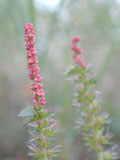
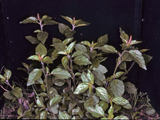
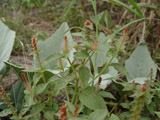
Well, you may have to learn to like Acalypha phleoides (shrubby copperleaf), or be more aggressive. It is native to this part of the state, and therefore very adapted to the rainfall, climate and soil. Since it is perennial, just pulling it off the root is not going to stop it from coming back up, as you have already pointed out. You can't spray it with herbicide, as it would kill all the other dicots or broad-leaved plants (like the straggler daisy) that you already have. If you buy a spray that is for monocots, or grasses, it won't bother the three-seeded mercury, but it could kill some native grasses that you have been cultivating.
The first thing to do is make sure it never has an opportunity to go to seed. Even though it is a perennial that can come up from the roots, it will also propagate itself by the seeds on those tall bracts. This might be a time to break your rule about never mowing; if you mow it before it can seed, and keep mowing it as it sends up more bracts to try to seed again, you might just wear out the food stored in the roots. Doing this for several weeks when the plant is trying to bloom, and thus set seed, could greatly alleviate your problem.
Beyond that is the somewhat labor-intensive, hands and knees on the ground, method of painting the cut stem with a wide spectrum herbicide. Begin with a small bottle of the herbicide and some disposable sponge brushes. Cut each stalk off near the root and quickly, within five minutes before the stalk starts to heal over to protect the roots, paint the cut edge with the herbicide. Be very careful, spilling this could contaminate the soil and kill the other plants, broad-leaf and grasses, and don't spray, for the same reason. This plant is monoecious, which means it has both male and female flowers on each plant, and each plant can carry on creating more plants with no outside help.
From our Native Plant Image Gallery:
More Invasive Plants Questions
Organic means for ridding garden of stinging ants
April 18, 2008 - Dear Mr. Smarty Pants,
I have a butterfly garden that is filled with native plants the butterflies LOVE! However I have a colony of red ants that have moved in. I need to trim some of the more inva...
view the full question and answer
Request for native grasses from Hillsboro TX
August 04, 2012 - P.S. I forgot to mention one very important fact: my neighbor specifically asked for "native grass" recommendations. He thought he was getting a native grass recommendation.
view the full question and answer
Mexican feathergrass from Pflugerville, TX
January 23, 2013 - How deep are the roots of Nassella tenuissima? I'm looking for something that could possibly discourage my neighbors' bermuda grass from encroaching into my native plantings.
view the full question and answer
Help for restoring landscape to indigenous native plants
November 05, 2007 - I have inherited some acres in Robertson County (Texas) which is about 40 miles north of Bryan/College Station. I would like to restore the landscape to the indigenous native plants without just lett...
view the full question and answer
Transplanting trumpet creeper in Prairie City, IA
August 22, 2011 - I have a Trumpet Creeper that I would like to transplant. How do you do that?
view the full question and answer
| Support the Wildflower Center by Donating Online or Becoming a Member today. |