Native Plants

Q. Who is Mr. Smarty Plants?
A: There are those who suspect Wildflower Center volunteers are the culpable and capable culprits. Yet, others think staff members play some, albeit small, role. You can torture us with your plant questions, but we will never reveal the Green Guru's secret identity.

Did you know you can access the Native Plant Information Network with your web-enabled smartphone?

Ask Mr. Smarty Plants
Ask Mr. Smarty Plants is a free service provided by the staff and volunteers at the Lady Bird Johnson Wildflower Center.

rate this answer

Thursday - November 12, 2009
From: Kensington, MD
Region: Mid-Atlantic
Topic: Grasses or Grass-like
Title: Clearing up the nativity of so-called Baltimore sedge (Carex senta)
Answered by: Nan Hampton
QUESTION:
Dear Smarty Pants: Hi, did you ever get more clarity on the Carex senta issue (baltimore sedge)? Whether or not it was a wetland grass? I too am in Maryland and was thinking of planting it for a lawn, but not if it's only native way out west. If you have any other recommendation for a shade-loving native for a lawn, that would be wonderful. thanks in advance.ANSWER:
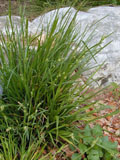
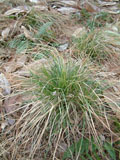
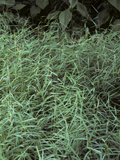
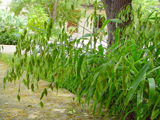
Carex senta (swamp carex) according to the USDA Plants Database is native to Arizona, New Mexico and California and according to the Flora of North America it grows along streams and in wet meadows in Arizona, California, and Mexico—not New Mexico. Someone apparently misidentified a sedge in New Mexico as C. senta when it was really Carex stricta (upright sedge). You obviously have read our previous question and answer concerning Carex senta but we still do not know why it is called 'Baltimore sedge' by some sources. USDA Plants Database says its common name is 'swamp carex' and Integrated Taxonomic Information System (ITIS) gives its common name as 'swamp carex' or 'swamp sedge'. Flora of North America didn't assign it a common name. If you have read Sedge Lawns for Every Landscape by John Greenlee (and I suspect you have), you know that he calls it 'Baltimore sedge', but we have no idea where he got the common name. The bottom line, however, is that Carex senta is not native to Maryland, despite its sometimes common name. We can, however, suggest some other shade-loving plants for lawns that are native to Maryland:
SEDGES AND GRASSES:
Carex blanda (eastern woodland sedge) and here are more photos and information and still more.
Carex pensylvanica (Pennsylvania sedge) and here are more photos and information and still more.
Muhlenbergia schreberi (nimblewill)
Chasmanthium latifolium (Inland sea oats), wouldn't be considered a turf grass, but it is very attractive even after seed heads have set.
Sorghastrum nutans (Indiangrass) is a tall attractive clumping grass.
GROUNDCOVER-TYPE WOODY AND HERBACEOUS PLANTS:
Gaultheria procumbens (eastern teaberry) evergreen.
Cornus canadensis (bunchberry dogwood)
Geum canadense (white avens) evergreen.
Linnaea borealis (twinflower) evergreen.
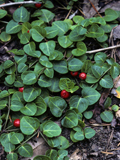
Mitchella repens (partridgeberry) evergreen.
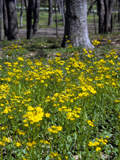
Packera obovata (roundleaf ragwort) evergreen.
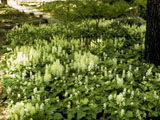
Tiarella cordifolia (heartleaf foamflower)
PHOTOS FROM OUR IMAGE GALLERY:

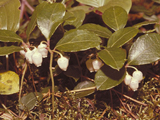
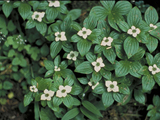
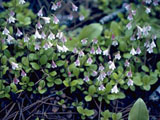
More Grasses or Grass-like Questions
What is Andropogon saccharoides?
August 06, 2008 - I am reading Roy Bedichek "Adventure with a Texas Naturalist" I came across a reference to sage grass (Andropogan saccharoides)p. 23. I searched the data base and didn't any infromation abou...
view the full question and answer
Using salt to kill bermuda grass
May 12, 2009 - (Submitting to site per your request on Facebook, plus an added bit o'info)
I am considering trying to kill off the bermuda grass around my raised bed with salt. Vinegar isn't cutting it.. S'pos...
view the full question and answer
When to plant bermudagrass in East Texas
July 17, 2009 - When to plant Bermuda grass in East TX, Center, Nacodoches, Lufkin and Center area?
view the full question and answer
Seed Habiturf on top of existing St. Augustine from Austin
January 26, 2012 - We don't want to rip up an existing St. Augustine lawn (potential HOA problems), but we'd like to go native grasses (like Habiturf?). Is there anything we can just seed on top of our present lawn a...
view the full question and answer
Evergreen native replacement for liriope
July 13, 2008 - What is a good native replacement for Liriope that is evergreen?
view the full question and answer
| Support the Wildflower Center by Donating Online or Becoming a Member today. |