Native Plants

Q. Who is Mr. Smarty Plants?
A: There are those who suspect Wildflower Center volunteers are the culpable and capable culprits. Yet, others think staff members play some, albeit small, role. You can torture us with your plant questions, but we will never reveal the Green Guru's secret identity.

Did you know you can access the Native Plant Information Network with your web-enabled smartphone?

Ask Mr. Smarty Plants
Ask Mr. Smarty Plants is a free service provided by the staff and volunteers at the Lady Bird Johnson Wildflower Center.

rate this answer

Thursday - October 01, 2009
From: Houston, TX
Region: Southwest
Topic: Trees
Title: Noise reduction hedge row in Houston
Answered by: Barbara Medford
QUESTION:
We live just one house back from the freeway and would like to plant a fast growing noise reduction 'hedge row' - close growing to 20-40 ft. We are looking at Leyland Cypress but know they aren't native to Texas. What are our choices? Thank you.ANSWER:
Actually, x cuprocyparis leylandii, (Leyland Cypress) is not native to anywhere; it is an accidental hybrid between a Cupressus macrocarpa (Monterey cypress) and Cupressus nootkatensis (Alaska cedar) when they were both in an English garden in the 1800's. The hybridization would have never happened otherwise, because the native areas of the two were 400 miles apart, in North America. Even if they were native to Texas, we would not recommend their use; see these two websites on the subject:
From About.com: Forestry Reconsider Planting Leyland Cypress in your Yard.
North Carolina State University Plant Pathology Extension Diseases of Leyland Cypress
We will try to find you a shrub or tree that would help dull the noise from the freeway, and we can certainly understand why you want it to grow FAST! Unfortunately, like the Leyland Cypress, fast-growing trees tend to be short-lived, to break down easily and sometimes do not have sufficient roots to support the extra height in a storm. You need something dense and evergreen, because the freeway still runs in winter, when the leaves are off deciduous plants. Some of these are classified as shrubs, some as trees. Unless you have a solid, noise barrier fence at the back of your property, you will probably not want to trim these up into tree form, but allow them to grow branches up from the ground. All are evergreen and native to the Houston area, and all grow within the stipulated ranges. Follow each link to the page on that individual plant for more information on its culture, bloom time and moisture requirements.
Sound barrier hedge plants for Houston:
Gordonia lasianthus (loblolly bay) - ranges from 30 to 80 ft
Ilex vomitoria (yaupon) - 12 to 25 ft. tall
Ilex opaca (American holly) - 20 to 60 ft.
Juniperus virginiana (eastern redcedar) - 30 to 40 ft.
Magnolia grandiflora (southern magnolia) - to 50 ft. tall
Magnolia virginiana (sweetbay) - 12 to 20 ft. tall
Prunus caroliniana (Carolina laurelcherry) - 15 to 20 ft. tall
From our Native Plant Image Gallery:
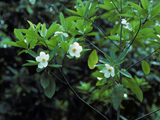
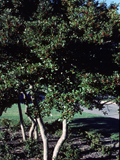
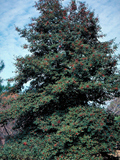
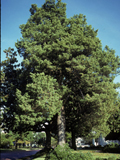
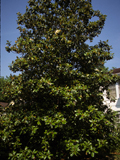
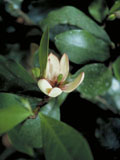
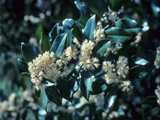
More Trees Questions
Mexican Plum not doing well in Liberty Hill, TX.
September 03, 2010 - Two summers have passed since I planted my Mexican Plum. It's in full sun. It seems to have added height but not much width. It's virtually a 7 foot stick with 1 foot branches from top to bottom. It...
view the full question and answer
Spots on persimmon tree leaves from Dripping Springs TX
July 10, 2013 - We are in rural Hays County Texas off Hamilton Pool Rd Texas. Large persimmon trees are turning yellow, blackish spots on underside of leaves. What do we do?
view the full question and answer
Difficulty of watering at drip line of trees from The Woodlands TX
August 18, 2011 - I'm watering my couple dozen native mature trees to make sure they survive this drought and its aftermath..and I'm reading about how to water at the drip line. But..all of my trees' drip lines ext...
view the full question and answer
Tree options for patio in Sun City West, Arizona.
January 07, 2011 - We have an area near our cement patio in Sun City West AZ where we would like to plant a shade tree. We planted a sissoo tree, but were told that the roots will damage the patio because of the proximi...
view the full question and answer
Evergreen for privacy in PA
July 18, 2011 - We need to plant a privacy/sound barrier hedge/hedgerow and my husband says it must be evergreen. I am not familiar with which species would be native to our area and I just don't trust those big sto...
view the full question and answer
| Support the Wildflower Center by Donating Online or Becoming a Member today. |