Native Plants

Q. Who is Mr. Smarty Plants?
A: There are those who suspect Wildflower Center volunteers are the culpable and capable culprits. Yet, others think staff members play some, albeit small, role. You can torture us with your plant questions, but we will never reveal the Green Guru's secret identity.

Did you know you can access the Native Plant Information Network with your web-enabled smartphone?

Ask Mr. Smarty Plants
Ask Mr. Smarty Plants is a free service provided by the staff and volunteers at the Lady Bird Johnson Wildflower Center.

rate this answer

Monday - September 07, 2009
From: San Antonio, TX
Region: Southwest
Topic: Trees
Title: Decline of mesquite and persimmon trees in San Antonio
Answered by: Barbara Medford
QUESTION:
We have lived in a house in San Antonio for about 30 years now and in the last 5 years, we have seen the decline of several mesquite and wild persimmon trees. I am wondering what would cause their demise! We water infrequently, and have the back yard planted in Hill Country Natives, as suggested by the landscape class at the Center. Overwatering is the only thing I can imagine, besides possibly that they are just at the end of their lifespan..ANSWER:
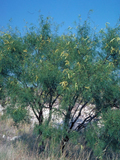
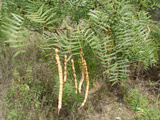
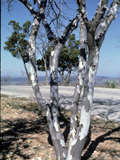
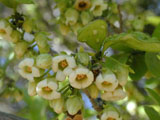
We are as puzzled as you are. Usually, when a plant is showing signs of decline, we look at what has changed in the environment, but if you have had these trees in the same spot getting the same care for 30 years, it doesn't seem that anything has changed in the environment. We are pretty sure we can tell you that neither tree has reached its normal lifespan, even though we couldn't find exact figures for either. Prosopis glandulosa (honey mesquite) has a normal lifespan of from 40 to 110 years, with maximum age from 172 to 217 years. Diospyros texana (Texas persimmon) is slow-growing, and ordinarily slow-growing plants have a longer life. Both trees are specified in our Native Plant Database as being drought and neglect tolerant, and with low water use. Both need full sun and good drainage.
So, about the best we can do is speculate. The mesquite has a long taproot to get deep water suppied, as well as a network of roots near the surface. You mentioned over-watering; are these two trees the only plants in your native plant garden suffering similar problems? We know we keep saying this over and over, but it's true that this extreme two-year drought is even causing problems with desert plants. Possibly the water table has dropped so low that not even the mesquite's long taproot can reach its subterranean sources any longer. We trust you haven't been fertilizing the trees; native trees should not need fertilizer, as they should be able to get their necessary nutrients and trace elements from the soil. Don't fertilize, never fertilize a plant under stress. With water rationing being invoked all over Central Texas, perhaps it would be better to just hang on, don't increase watering, and maybe it will rain again sometime.
If other gardeners are having similar problems, hopefully your Texas A&M AgriLIFE Extension Office for Bexar County will have some closer-to-home advice.
More Trees Questions
Small tan balls on oak from Pipe Creek TX
May 21, 2014 - Dear Mr. Smarty Plants, our spanish oak is growing tan colored lumpy balls about the size and weight of a marshmallow..sometimes just one at the end of a short stem and sometimes 2-3 clumped together....
view the full question and answer
Texas ash tree splitting in Denton TX
April 03, 2010 - I have a Texas ash tree that's splitting in its center and need some info re cable tie or other techniques to fuse the crotch together. I have temporarily placed two bands of plastic cable ties just...
view the full question and answer
Black walnut herbivory
June 13, 2005 - We moved to Texas just about a year ago and have loved it here. This past January we visited the Wildflower Center and obtained some black walnut seeds. Up until last night the tree was doing well p...
view the full question and answer
Soapberry Transplant shock symptoms
July 21, 2006 - Please suggest a cause & cure for general yellowing of the leaves of Western Soapberry when planted in the ground 20 miles NW of Austin (thin, poor clay over limestone). Trees still in containers are...
view the full question and answer
Can trees survive if trunks are buried under 3-5 ft of soil?
January 27, 2012 - We have two cedar elms and a mesquite that I protected from backfill as our Texas Hill Country lot was leveled in preparation for building a house. The bulkheads are now holding back 3' to 5' of ma...
view the full question and answer
| Support the Wildflower Center by Donating Online or Becoming a Member today. |