Native Plants

Q. Who is Mr. Smarty Plants?
A: There are those who suspect Wildflower Center volunteers are the culpable and capable culprits. Yet, others think staff members play some, albeit small, role. You can torture us with your plant questions, but we will never reveal the Green Guru's secret identity.

Did you know you can access the Native Plant Information Network with your web-enabled smartphone?

Ask Mr. Smarty Plants
Ask Mr. Smarty Plants is a free service provided by the staff and volunteers at the Lady Bird Johnson Wildflower Center.

rate this answer

Sunday - August 23, 2009
From: Savage, MN
Region: Midwest
Topic: Diseases and Disorders
Title: Failure to thrive of trees in Savage MN
Answered by: Barbara Medford
QUESTION:
I have a 20+ year old weeping willow. The last few years it is the last tree to get its leaves and the first to lose them. The few leaves that are still on the tree are covered with brown/black spots. I also have a 20+ year old Marshall's Seedless Ash in a different area. It's lost most of the leaves from the center of the tree. Many of the leaves that remain have some yellow to brown spots in the center and/or are brown at the edges. Any suggestions? Thank you.ANSWER:
Thank you for your question. While we would like to answer all questions we receive, Mr. Smarty Plants' expertise is limited to plant species native to North America, their habitats and cultivation. Limited resources require us to decline answering questions that delve into other areas. We hope you understand.
Non-native to the United States, Salix x sepulcralis is a hybrid of a Chinese species (Peking willow) and a European species (white willow), and is said to grow in Zones 5 to 8 in the United States. We are astounded that it has lived as long as it has, since you are in Zone 4a, with average annual minimum temperatures of -30 to -25 deg. F. It is weak-wooded, fast-growing and, therefore, short-lived. It has aggressive roots, can lift sidewalks and interfere with sewer lines, often growing on soil surface, making a problem with mowing. It is susceptible to a number of pests and diseases, and notorious for littering the ground beneath it. You might check out this University of Florida Extension website on Weeping Willows for more information as well as this Q&A from North Dakota State University Extension on weeping willows.The UBC Botanical Garden Forum is also a good source of information on non-native plants.
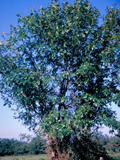
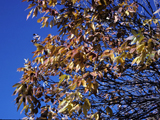
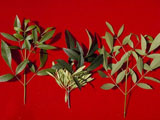
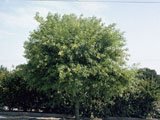
Fraxinus pennsylvanica (green ash) has been given the trade name which is discussed in this USDA Forest Service 'Marshall's Seedless' Green Ash. It is hardy in Zones 3 to 8a, and native in and around Scott County in Minnesota, so it belongs there. However, like the weeping willow, it is fast growing, has roots which can disrupt foundations and sidewalks, and is short-lived. In fact, the USDA article mentioned above "no longer recommends this tree due to weak branch crotches, insect problems and fruit set." Since we are not plant pathologists and couldn't hope to diagnose or recommend treatment at this distance, we suggest you contact the University of Minnesota Extension Office for Scott County. They may recommend you have it looked at by a trained and licensed arborist, if you feel the tree is worth saving.
From the Native Plant Image Gallery:
More Diseases and Disorders Questions
Texas Ash secreting sap in Lockhart, TX
July 05, 2012 - I have what I believe is a Texas Ash in my front yard that is secreting a sap with what looks like some wounds on it with some white stuff and with black and red looking ants as well as it has a lot o...
view the full question and answer
Brown rings on grass under live oaks in Austin
June 13, 2013 - There are brown rings in the grass at the dripline on several Live Oak trees in our neighborhood. What causes this? The trees appear healthy.
view the full question and answer
Green worms on salvias
October 12, 2008 - I recently bought a "salvia blue chiquita." Some leaves were yellowing, but full of flowers and still attractive. Have had it on my deck for less than a week and have found 2 tiny greenish "worms...
view the full question and answer
Fuzzy Citrus Fruit on Satsuma and Lemon Trees
September 13, 2014 - A man asked you about fuzzy little small fruit-like balls that looked like tiny lemons. I have huge numbers of these on both my mature Satsuma and lemon tree this year. I get 100's of really great f...
view the full question and answer
Leaves of non-native crape myrtle browning in Sinton TX
June 12, 2010 - Crepe myrtle – tips of leaves are brown and curling up.
view the full question and answer
| Support the Wildflower Center by Donating Online or Becoming a Member today. |