Native Plants

Q. Who is Mr. Smarty Plants?
A: There are those who suspect Wildflower Center volunteers are the culpable and capable culprits. Yet, others think staff members play some, albeit small, role. You can torture us with your plant questions, but we will never reveal the Green Guru's secret identity.

Did you know you can access the Native Plant Information Network with your web-enabled smartphone?

Ask Mr. Smarty Plants
Ask Mr. Smarty Plants is a free service provided by the staff and volunteers at the Lady Bird Johnson Wildflower Center.

rate this answer

Saturday - August 08, 2009
From: Tucson, AZ
Region: Southwest
Topic: Compost and Mulch, Pests, Transplants, Trees
Title: Disappearance of leaves on desert willow in Tucson AZ
Answered by: Barbara Medford
QUESTION:
We have a Lois Adams Desert Willow (Tucson, Az). The leaves will pump out and then a day or so later, all of the leaves are gone. The only bugs we've seen on it are very, very small ants. Could this be what is eating the leaves? We have two other desert willows in different locations; however, they are doing great.ANSWER:
That is strange, trees on the same property, one losing its leaves and the other two doing fine. About all we can do is give you some questions to ask yourself to try to find the solution. Chilopsis linearis (desert willow) is an excellent plant for the Tucson area, adapted to the arid heat and soils.
First, you need to consider what, if any, change there has been in the environment of the tree involved. Is it a recently planted tree? In the very intense heat and drought the entire Southwest is suffering, transplant shock would be high on the list of possibilities, particularly if the tree was planted after hot weather began. We recommend that trees be planted in the late Fall or early Winter in the Southwest. the tree is semi-dormant then, and can cope much better with the heat in the Spring when it has had time to develop its roots.
Have the leaves begun to drop suddenly, are there dead leaves on the ground? How is the drainage of the tree? The desert willow is considered a good candidate for canyon sides and prevention of erosion, because it doesn't need much water, but it does need good drainage. Water standing on the roots of this tree could be causing the problem, just as surely as failure to get enough water. If the tree is in a different soil or drainage situation than the two healthy ones, that should be considered right away. If you water the tree, and water stands on the surface, this probably means you do not have good drainage. You can try to work a little compost in around the roots, and then cover the roots with shredded bark mulch, which will both shade the roots, hold in moisture without water standing on roots, and as it decomposes, continue to contribute to the amending of the soil.
If either of those first two situations seem to be the problem, we suggest treating it as transplant shock. Trim off the upper 1/4 to 1/3 of the limbs (yes, flowers and all). Do what you can to improve the drainage, and then make sure the tree is getting adequate moisture, even if you have to run a hose to it. No fertilizer; native plants don't need fertilizer, they can get their nutrients from the soil they are accustomed to.
To consider the ants you have observed, about the only ant that can remove virtually a whole leaf and make off with it is the leafcutter ant. Read this article from San Juan's The Lurker's Guide to Leafeater Ants, What are leafeater ants? If you can't find a trail or an anthill and don't observe the leaves being carried away, it's not likely that's the problem.
Most insect pests tend to make holes in leaves, not carry them off. We are going to give you references to websites about some common leaf predators, aphids, spider mites, whitefly and thrips. Examine your tree for clues to those insects being present and the websites will also have control suggestions.
Aphids- University of California Integrated Pest Management
Thrips - University of California Integrated Pest Management
Whitefly - University of California Integrated Pest Management
Spider mites - University of California Integrated Pest Management
These insects are all considered not particularly dangerous to the desert willow; however, a tree already in bad condition for some other reason is an easy target for damage from insects and disease. Our suggestion is that you examine your tree, try to determine what is wrong, and if you still don't have the answer, get in contact with the University of Arizona Cooperative Extension Home Horticulture Office for Pima County. They are probably going to ask you the same questions we have and, being closer to the situation, hopefully will have suggested solutions.
Pictures from our Native Plant Database Image Gallery:
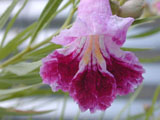
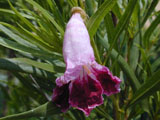

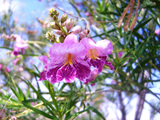
More Transplants Questions
Newly planted anacacho leaf browning
October 15, 2007 - I have just put my anacacho orchid into the ground and its leaves are turning brown and falling off. Is that normal for this time of year, or have I shocked it? What can I do to ensure its health?
view the full question and answer
When is best time to transplant Ezperanza shrubs in Buda, TX?
September 02, 2013 - I need to transplant 2 huge Esperanza's...when is the best time to uproot them and not kill them?
view the full question and answer
Native plants for sandy soil and not much water
April 14, 2008 - I am planning a new garden at home and would like to grow native plants that can handle sandy soil and don't need much water. I do not water my gardens.I would prefer plants that can have more than o...
view the full question and answer
Propagation of Lime Prickly Ash in Austin
March 22, 2010 - We found only one small what we think is Zanthoxylum fagara or Lime Prickly Ash, Colima on our 8 acres, and the deer had apparently recently broken the main stem. I quickly made 6 or 7 cuttings, dippe...
view the full question and answer
Non-native Ruda plant drying up in Florida
February 19, 2009 - I have a RUDA plant at work, but do not know if I am putting too much water on it, it is about 1 meter high but I think is drying up. How often do I water it? I'm in Miami Fl.
Thank you.
view the full question and answer
| Support the Wildflower Center by Donating Online or Becoming a Member today. |