Native Plants

Q. Who is Mr. Smarty Plants?
A: There are those who suspect Wildflower Center volunteers are the culpable and capable culprits. Yet, others think staff members play some, albeit small, role. You can torture us with your plant questions, but we will never reveal the Green Guru's secret identity.

Did you know you can access the Native Plant Information Network with your web-enabled smartphone?

Ask Mr. Smarty Plants
Ask Mr. Smarty Plants is a free service provided by the staff and volunteers at the Lady Bird Johnson Wildflower Center.

rate this answer

Sunday - August 02, 2009
From: Katy, TX
Region: Southwest
Topic: Shade Tolerant
Title: Shade trees not invasive to foundations and driveways
Answered by: Nan Hampton
QUESTION:
I am in zone 9. What shade trees can I plant that will not be invasive to foundations or driveways? Thank you, Mr. Smarty PlantsANSWER:
The general thought is that trees with tap roots will prevent damage to nearby driveways, sidewalks and foundations. Certainly, avoiding trees with extensive lateral roots will help prevent damage. Mr. Smarty Plants answered a similar question a few days ago so part of the following is excerpted from the answer to that question:"Although trees are generally divided into two groups by root type—tap root trees (such as oaks, hickory, walnut, conifers) and lateral, or fibrous, root trees (maples, ash, cottonwood)—this distinction is most evident as seedlings or saplings. Once the tree is planted and begins to mature, the distinctions between the root types become less pronounced. Then, the depth and lateralness of the roots is greatly dependent on the soil condition. Highly compacted soils, soils with low oxygen content and soils where the water table is near the surface are not likely to produce a strong tap root. Their roots are more likely to be lateral and located very near the surface with the majority of the roots located in the top 12 inches of soil. Also, it is important to realize that the spread of the roots can be at least 2 to 4 times greater than the drip line of the branches.
You can read the recommendations from Iowa State University Extension Service for Sidewalks and Trees which bases the distance trees should be planted near pavement on the mature height of the tree. Their recommendations are:
1. trees with a mature height of less than 30 feet, 3-4 feet from pavement,
2. trees with a mature height of 30 to 50 feet, 5-6 feet from pavement,
3. trees with a mature height of greater than 50 feet, at least 8 feet from pavement.
You could consider installing some sort of root barrier between the tree and the wall. Here is more information about root barriers."
Here are some large shade trees that are considered tap root trees that are recommended for Harris County:
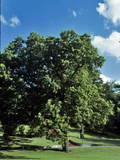
Quercus macrocarpa (bur oak) and more information
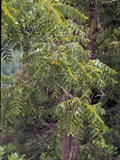
Juglans nigra (black walnut) and more information
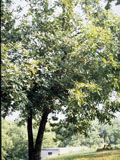
Carya illinoinensis (pecan) and more information
Ostrya virginiana (hophornbeam) and more information
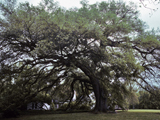
Quercus virginiana (live oak) and more information
Quercus alba (white oak) and more information
You can use the Texas Forest Service Texas Tree Planting Guide to select other trees according to your own criteria.


More Shade Tolerant Questions
Central Texas plants for dry partial shade
April 17, 2007 - I live in Austin Texas. My front garden area has rocky dry soil with intermittent sunlight and shade, maybe 2 to 4 hours of sunlight a day. Herbs do great. What perennial flowers (for some color) w...
view the full question and answer
Deer resistant, drought and shade tolerant plants to go under oak tree in Austin
March 21, 2011 - What is the best deer resistant, drought resistant native plant to grow under my huge Oak tree? Grass does not grow. Will iris bloom?
view the full question and answer
Evergreens for privacy in VA
June 24, 2012 - I need fast growing evergreens or large shrubs, flowering or non-flowering, for privacy. They will need to flourish among large oak and hickory trees that are 75 plus years old. We don't want to dama...
view the full question and answer
Shade tolerant vines for Mobile AL
May 07, 2013 - I am looking for an evergreen vine that will thrive in the shade in hot and humid south Alabama. I plan to plant on a trellis. A flowering vine would be even better.
view the full question and answer
Wildflowers suitable for full sun and partial shade in the Dallas, Texas area
October 22, 2007 - What wildflowers are best for the Dallas area both in sunny and semi shade locations? Are you able to purchase by mail?
view the full question and answer
| Support the Wildflower Center by Donating Online or Becoming a Member today. |