Native Plants

Q. Who is Mr. Smarty Plants?
A: There are those who suspect Wildflower Center volunteers are the culpable and capable culprits. Yet, others think staff members play some, albeit small, role. You can torture us with your plant questions, but we will never reveal the Green Guru's secret identity.

Did you know you can access the Native Plant Information Network with your web-enabled smartphone?

Ask Mr. Smarty Plants
Ask Mr. Smarty Plants is a free service provided by the staff and volunteers at the Lady Bird Johnson Wildflower Center.

rate this answer

Tuesday - July 07, 2009
From: Loda, IL
Region: Midwest
Topic: Herbs/Forbs
Title: Yellowing leaves on Jack in the Pulpit in Loda IL
Answered by: Barbara Medford
QUESTION:
I live in central Illinois and have a Jack in the Pulpit in a pot, in a shady location, under an oak tree and the soil seems to be moist. The leaves are turning yellow at the edges. Help, please. Thank you.ANSWER:
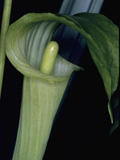
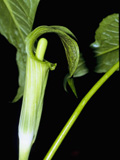
There are three members of the Arisaema genus native to Illinois that have "Jack in the Pulpit" as their common name:
Arisaema triphyllum (Jack in the pulpit)
Arisaema triphyllum ssp. pusillum (Jack in the pulpit) - pictures
Arisaema triphyllum ssp. triphyllum (Jack in the pulpit)
They are obviously very closely related, and it really doesn't matter which one, or another not native to Illinois, you are growing, they pretty well share the same growing needs. From Paghat's Garden, here is a website on the species and sub-species listed above, with pictures.
From our Native Plant Database page on Arisaema triphyllum (Jack in the pulpit), here are the growing conditions for that plant:
"Water Use: High
Light Requirement: Sun , Shade
Soil Moisture: Wet , Moist
CaCO3 Tolerance: Medium
Soil Description: Humus-rich, moist soils.
Conditions Comments: Jack-in-the-pulpit is an excellent woodsgarden plant, very easy to cultivate and requiring very little care. It thrives under a variety of conditions, but grows most vigorously in moist, shady, seasonally wet locations. A heavy, leafy wintercover should be left in place."
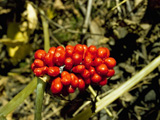
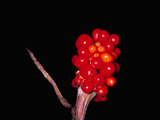
Every resource on these plants that we consulted said that the plants need an acidic soil, which you would ordinarily find on a forest floor, due to the constantly falling leaves of deciduous trees around them. We learned also that these plants go dormant in the summer, with mature plants producing red berries visible in mid to late summer.
We have a couple of theories on why your plant's leaf edges are yellowing. The first is concerning the soil in the pot where the Arisaema is growing. When leaves begin to yellow on a plant, we usually suspect chlorosis, which means the plant is not getting trace elements from the soil that it needs. A plant needing an acid soil would have great difficulty in accessing those elements, especially iron, in an alkaline soil. If you are using a commercial potting soil, it might very well be that the plant would be better off in the ground itself, which is probably more suited to an acid-loving plant. Our second theory has to do with the dormancy of the plant in summer. It could possibly be that the dormancy is beginning in that plant, and the yellowing of the leaves is a natural part of that process.
We would suggest that you just keep an eye on the plant, and if you feel the pH of the soil in the pot is questionable, transplant into the native soil at the appropriate time.
More Herbs/Forbs Questions
Flowering plant for gravesite in Weatherford TX
June 23, 2013 - I want to plant flowering plant of some kind at parent's grave site in Weatherford, TX. The family cemetery is on a limestone hill with no irrigation or ability to water other than nature. Would on...
view the full question and answer
Schedule for planting perennial wildflowers from Asheville NC
March 22, 2013 - When is the best time to plant perennial wildflowers?
view the full question and answer
Plant identification from Springfield MA
July 19, 2009 - We have a house next to us that is vacant. The lawn has not been mowed in months. a tall flower has grown amongst the grass and weeds. It is about 3 to 4 feet tall green stem and the flower is about 2...
view the full question and answer
Trimming of penstemon after bloooming from Austin
April 30, 2012 - I planted a penstemon in my backyard last fall and it's doing great. Once the flowers have bloomed, do I cut the stalk back? It is about 2 ft tall and doesn't appear to be doing anything. I belie...
view the full question and answer
Trees for cutout in driveway in Houston
November 12, 2010 - I live in central Houston. I have a new driveway with a cutout of 4' x 8'. I would like to plant a shade tree that will not break up the concrete. What do you recommend?
view the full question and answer
| Support the Wildflower Center by Donating Online or Becoming a Member today. |