Native Plants

Q. Who is Mr. Smarty Plants?
A: There are those who suspect Wildflower Center volunteers are the culpable and capable culprits. Yet, others think staff members play some, albeit small, role. You can torture us with your plant questions, but we will never reveal the Green Guru's secret identity.

Did you know you can access the Native Plant Information Network with your web-enabled smartphone?

Ask Mr. Smarty Plants
Ask Mr. Smarty Plants is a free service provided by the staff and volunteers at the Lady Bird Johnson Wildflower Center.

rate this answer

Sunday - June 21, 2009
From: Covington, LA
Region: Southeast
Topic: Grasses or Grass-like
Title: Native grasses for wildlife in Katrina recovery area of Louisiana
Answered by: Nan Hampton
QUESTION:
I live in La in an area decimated by Katrina and want to establish 11 acres of wildlife friendly native short grasses. It is partly designated wetlands because it floods, but also has long periods without much water, and of course, there are not many trees yet. What are the best selections? Thank you.ANSWER:
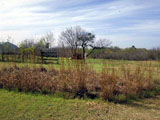
Mr. Smarty Plants commends you on your project! You can actually search for these yourself by doing a COMBINATION SEARCH on our Native Plant Database by selecting Louisiana from the Select State or Province and 'Grass/Grass-like' from Habit (general appearance) and 'Wet - soil is saturated with water' from Soil moisture. This will give you more than 40 choices. it is possible that for some of your area you can use grasses that live in moist soil. If you add that choice to your search, you will get more than 70 choices. Of course, not all of those are going to be short grasses or necessarily wildlife friendly, so I'm going to recommend several that I think should do well for you. I'm going to include some tall bunchgrasses for you to consider as well because of their attractiveness and suitability for wildlife.SHORTER GRASSES AND GRASS-LIKE PLANTS
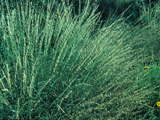
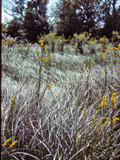
Andropogon glomeratus (bushy bluestem) is a very attractive grass in all seasons that does well in wet areas and is larval host for several butterflies.
Bouteloua curtipendula (sideoats grama) provides food for birds and butterflies. It would do well out of the flooded areas in moist soils.
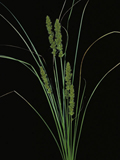
Carex stipata (owlfruit sedge) grows well in wet soils in the sun and is an important food for the swamp sparrow.
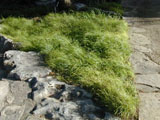
Carex texensis (Texas sedge) grows to less than 1 foot tall in sun and part shade in moist areas.
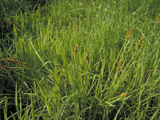
Carex vulpinoidea (fox sedge) grows in wet or moist soil in the sun and attracts birds.
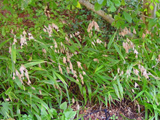
Chasmanthium latifolium (Inland sea oats) is an attractive grass that is larval host to several butterflies and its seeds are used by birds and other wildlife. It does best in part shade or shade.
Eleocharis montevidensis (sand spikerush) grows well in low wet areas in full sun and is food for waterfowl and shorebirds.
Eragrostis spectabilis (purple lovegrass) grows in moist soils in full sun to less than 2 feet and provides nesting cover for birds.
Poa arachnifera (Texas bluegrass) grows to less than 2 feet in moist soils in sun or part shade. Seeds provide food for birds and small mammals. Also, it attracts butterflies.
TALLER GRASSES
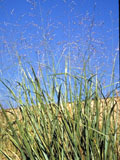
Andropogon gerardii (big bluestem) can withstand periodic flooding as well as drought conditions. It provides food and shelter for more than 20 bird species and is a larval host to several butterflies and moths.
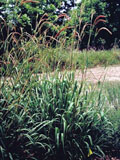
Panicum virgatum (switchgrass) grows in moist soils in the sun and part shade and is larval host and nectar source for several butterflies.
Sorghastrum nutans (Indiangrass) is an attractive tall grass with seeds that provide food for small mammals and birds and also attracts butterflies.
Spartina alterniflora (smooth cordgrass) can grow in moist or wet brackish to very salty soils but is not drought tolerant. Its seeds are eaten by a variety of birds.
Tripsacum dactyloides (eastern gamagrass) has attractive flower heads and its seeds are eaten by deer and birds.
You also might find some or all of the articles under "Large Scale Wildflower Planting" in our How-to Articles useful to your project.


More Grasses or Grass-like Questions
Advice about buffalo grass lawn in NW Arkansas
June 10, 2014 - I am determined to grow a native buffalo grass (bouteloua) lawn in Northwest Arkansas. My question is this: I am considering mixing an annual rye into the bouteloua seed mix for the purpose of quick, ...
view the full question and answer
Plants for a Narrow, Dry, Shaded Site in Georgia
April 03, 2014 - I am writing from Valdosta, GA. Could you please suggest three perennial shrubs and/or plants that flower at different times of the spring and summer? Also ones that can be planted in a 2 ft. wide s...
view the full question and answer
Groundcover for Austin yard
March 08, 2012 - My main goal is to cover my yard with a "grass" or groundcover that can handle the Texas heat, predicted long drought and some dog paw traffic (without going dormant/brown in the winter). I don't n...
view the full question and answer
Top soil dressing for bermudagrass
February 25, 2009 - Need to apply top soil dressing to bermudagrass. Can you suggest any type? This area is heavy clay soil and need to even out the lawn as well as feed the grass.
view the full question and answer
Lawn grass for Erath County, TX
October 02, 2012 - We live in Erath County in TX on ranch land. We are relatively dry. Our soil is combination of clay and red soil (brought in for building pad), and sandy. We have a sloped area, about 30%, that we w...
view the full question and answer
| Support the Wildflower Center by Donating Online or Becoming a Member today. |