Native Plants

Q. Who is Mr. Smarty Plants?
A: There are those who suspect Wildflower Center volunteers are the culpable and capable culprits. Yet, others think staff members play some, albeit small, role. You can torture us with your plant questions, but we will never reveal the Green Guru's secret identity.

Did you know you can access the Native Plant Information Network with your web-enabled smartphone?

Ask Mr. Smarty Plants
Ask Mr. Smarty Plants is a free service provided by the staff and volunteers at the Lady Bird Johnson Wildflower Center.

rate this answer

Tuesday - June 16, 2009
From: Duluth, GA
Region: Southeast
Topic: Grasses or Grass-like
Title: Replacing grass on steep hill in Georgia
Answered by: Nan Hampton
QUESTION:
I live near Atlanta, Georgia. My yard is a steep hill, which makes mowing VERY challenging. If possible, I would like to remove the grass and plant something hardy that does not require mowing. What plant(s) would be best? Also, when replacing grass, should I turn the soil with a tiller? I'm definitely an inside person, so I know precious little about plants and yard work. Thanks!ANSWER:
Mr. Smarty Plants hates to tell you this, but removing the grass on your steep lawn is going to present you with an immediate NEW problem—erosion! Grasses with their extensive fibrous root systems are ideal plants to prevent erosion on steep slopes. Although tilling is one way to get rid of the tall grass, it will leave you very susceptible to erosion uniess you get something else with extensive roots in the ground to stabilize it quickly. If you really want to get rid of your grass, solarization is a better option. Native American Seed in Junction, Texas has a very good description of how to do this. You can read about other Grass Removal Methods from Sonoma County (California) Master Gardeners.
Now for a replacement—have you considered replacing your fast-growing tall grass with a short native grass that needs very little mowing or watering? Bouteloua dactyloides (buffalograss) is a sun-loving grass native to Georgia that has varieties that grow to only 4-inches high. Another possibility is to replace the grasses with grass-like sedges. You can read Sedge Lawns for Every Landscape by John Greenlee to learn more about them. A carefully chosen sedge species has the advantage of having a maximum height of 4 to 10 inches and being evergreen. Here are two good candidates: Carex pensylvanica (Pennsylvania sedge) and Carex texensis (Texas sedge).
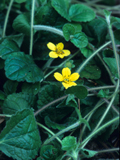
The following are low-growing evergreen plants that would serve well as groundcovers if you replace your grass. You should compare the required growing conditions of each of these to the characteristics of your site.
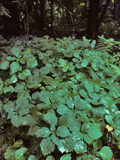
Chrysogonum virginianum (green and gold)
Pachysandra procumbens (Allegheny-spurge)
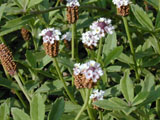
Phyla nodiflora (turkey tangle fogfruit)
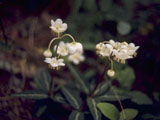
Chimaphila maculata (striped prince's pine)
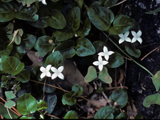
Mitchella repens (partridgeberry)
More Grasses or Grass-like Questions
Rejuvenating old Lindheimer muhly clumps
October 02, 2015 - I've got two clumps of Lindheimer's muhly in full sun in the western (limestone) part of Austin. I'm thinking they've been there for the past 8 or so years. In the past two or three years, the g...
view the full question and answer
Need help with lawn that was sodded with Buffalo Grass in Dallas, TX.
March 20, 2012 - I had buffalo sod put down last March. It greened up beautifully until weeds just about covered it up. I tried hand pulling. My landscaper showed up with something that appeared to damage the buffa...
view the full question and answer
Would Habiturf or buffalograss work in Charlottesville VA
July 18, 2012 - Hello,
I am looking for an alternative to traditional turf grasses. I stumbled upon some information on your site about buffalo grass and LBJWC's 'Habiturf' mix and would like to know if this w...
view the full question and answer
Groundcover for Austin yard
March 08, 2012 - My main goal is to cover my yard with a "grass" or groundcover that can handle the Texas heat, predicted long drought and some dog paw traffic (without going dormant/brown in the winter). I don't n...
view the full question and answer
Phytoremediation using Paspalum vaginatum
February 06, 2015 - Do you know of any on-going research using Paspalum vaginatum as the prime plant (monoculture) for use in phytoremediation.
Utilizing this plant in Vegetated Swales, Spreader Swales, Grassy Swales,...
view the full question and answer
| Support the Wildflower Center by Donating Online or Becoming a Member today. |