Native Plants

Q. Who is Mr. Smarty Plants?
A: There are those who suspect Wildflower Center volunteers are the culpable and capable culprits. Yet, others think staff members play some, albeit small, role. You can torture us with your plant questions, but we will never reveal the Green Guru's secret identity.

Did you know you can access the Native Plant Information Network with your web-enabled smartphone?

Ask Mr. Smarty Plants
Ask Mr. Smarty Plants is a free service provided by the staff and volunteers at the Lady Bird Johnson Wildflower Center.

rate this answer

Wednesday - May 13, 2009
From: Austin, TX
Region: Southwest
Topic: Turf
Title: Eliminating stinging nettles in lawn in Austin
Answered by: Barbara Medford
QUESTION:
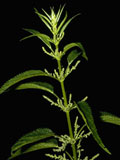
How do I get rid of stinging nettle that is dispersed through my lawn. It's not like the nettle pictures I see online - they are short plants and have narrow leaves - but covered with spines. Mowing does not reach them.ANSWER:
You are correct, the pictures you find online of Urtica dioica (stinging nettle) and Urtica dioica ssp. gracilis (California nettle) show a tall slender plant with nasty little spines. The difference is, you are mowing those nettles in your lawn, when you mow the lawn. They would rather grow up tall, but you won't let them, so they are doing the best they can to survive. So, what to do? Do you or your children or your pets run around on the lawn barefoot (or -paw)? Is it killing your grass? Do you belong to the school of "just mow it, it's green"? It may be something to tolerate or ignore. A very healthy lawn allowed to grow a little taller than usual will usually shade out and out-compete a weed. It is a perennial, so it will regrow from the roots even if you have kept it mowed low enough to prevent blooming and formation of seeds.
The Lady Bird Johnson Wildflower Center neither recommends for nor against herbicides, but if you're determined to try to get rid of the nettles, you may have to use some. You need to be very careful what you buy and follow the application instructions closely. The grass in your lawn is a monocot. Most weeds, including the nettles, are dicots, or broadleaf weeds. The "weed and feed" fertilizers that are highly advertised in the spring are designed to kill only dicots. The problem with broadcasting or spraying something like that is that the ornamental shrubs, flowers and trees in your garden are also dicots. A puff of wind (which we have in BIG puffs all the time in Austin), an indiscriminate aiming of the applicator or just an accidental spill could have disastrous effects on some of your prize plants. Not only that, but watering or rain is carrying excess herbicides and pesticides down to our water supply, where they end up in your glass of water. We would really rather you give the grass a chance to overcome the enemy on its own before you start chemical warfare.

More Turf Questions
Calyptocarpus vialis, Horseherb, for shady, mowable lawn
April 06, 2007 - Graham, Texas, Heavily wooded. Too shady for St. Augustine grass. Need mowable ground cover near house. Have heard of something called horsewort, but not able to find anything about it.
view the full question and answer
Mowing the multi-species buffalo grass lawn
June 23, 2011 - I am planning on putting in a buffalo grass lawn in an area that is little used. I read that a mix of buffalo, blue grama, and curly mesquite is good for better cover but I am concerned about the blu...
view the full question and answer
White mold on Bermuda grass
August 07, 2012 - I tried searching and could not find info for this on your website. What causes mold in Bermuda grass and how can I get rid of it? Tried fungicide as recommended by garden center in austin which did...
view the full question and answer
Lawn care?
May 10, 2009 - I had red yucca planted in my garden last May. They were trimmed back by my lawn care people last winter and currently seem to be slowly growing back. However, the red flower stalk is not growing ba...
view the full question and answer
Do I need to cover my Habiturf planting with straw?
March 02, 2012 - I'm preparing to seed the Habiturf in my front yard in a couple of weeks. My dad has suggested I spread some straw to help protect the seeds. Your thoughts? Thanks!!!
view the full question and answer
| Support the Wildflower Center by Donating Online or Becoming a Member today. |