Native Plants

Q. Who is Mr. Smarty Plants?
A: There are those who suspect Wildflower Center volunteers are the culpable and capable culprits. Yet, others think staff members play some, albeit small, role. You can torture us with your plant questions, but we will never reveal the Green Guru's secret identity.

Did you know you can access the Native Plant Information Network with your web-enabled smartphone?

Ask Mr. Smarty Plants
Ask Mr. Smarty Plants is a free service provided by the staff and volunteers at the Lady Bird Johnson Wildflower Center.

rate this answer

Tuesday - March 17, 2009
From: Ramsey, MN
Region: Midwest
Topic: Invasive Plants
Title: Getting rid of sandburs in horse pasture in Minnesota
Answered by: Barbara Medford
QUESTION:
How do I get rid of sandburs in my horse pasture?ANSWER:
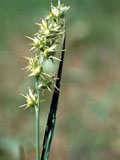
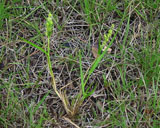
Lest you think you are the only one blessed with this noxious weed, please read this previous Mr. Smarty Plants answer. You didn't say what was in your horse pasture, but we are assuming it is grass of some sort. The problem with any kind of chemical control is that Cenchrus spinifex (coastal sandbur) is also a grass, member of the family Poaceae; something that kills the sandbur will also kill the surrounding grass.
Actually, the sandbur species mentioned above is more a product of the Southern United States; it is likely that what you have in Minnesota is Cenchrus longispinus (did you ever hear a more appropriate plant name?). This University of Minnesota Extension website Sandburs by Deborah L. Brown discusses this plant in Minnesota.
Frequently, when we tackle the treatment of weedy invasive plant, about the only advice we can give is to pull it out. We realize this is probably a big task in a horse pasture. One suggestion that we noted was that the sandbur tended to take hold in disturbed, poor soil, and that enriching the grasses you wanted to stay could discourage the survival of the weeds. Learn to recognize it when it has not yet produced the burs, or seeds, so you can pull it out as the opportunity arises and prevent the next generation, at least of that one plant. Sandburs are definitely survivors, with their seeds adapted to cling to clothing, fur, shoes and skin! Extra nourishment, high nitrogen fertilizers, and perhaps more moisture can help to enrich the good grasses and crowd out the bad ones.
More Invasive Plants Questions
Invasive plants in native plant area from Austin
May 15, 2012 - Why do invasive plants grow in native plant territory?
view the full question and answer
Covering dead arborvitae with non-native ivy from Niles MI
April 14, 2013 - I have a severely thinning arborvitae hedge. It is probably too shady, but I want the privacy. I'm thinking of planting something like ivy to fill the gaps. I know it will probably kill the hedge, bu...
view the full question and answer
Eliminating kudzu from Richmond KY
March 26, 2014 - I live in Richmond KY, Kirksville area. I have noticed that Kudzu has started to grow in my patch of land next to the creek. How can I get rid of this before it becomes a big problem?
view the full question and answer
Poverty Weed in Wimberley, Texas
September 20, 2008 - I have seen differing reports about the native plant, Baccharis neglecta or Poverty Weed. Some reports say it is invasive and others consider it an acceptable native plant. I have quite a few Povert...
view the full question and answer
How to deal with suckers on Flame-leaf Sumac
May 20, 2013 - Hi! It seems you can have too much of a good thing! Our flameleaf sumac is taking over our yard. There are multiple shoots appearing in our flower beds and in the lawn. How do I get rid of the unwante...
view the full question and answer
| Support the Wildflower Center by Donating Online or Becoming a Member today. |