Native Plants

Q. Who is Mr. Smarty Plants?
A: There are those who suspect Wildflower Center volunteers are the culpable and capable culprits. Yet, others think staff members play some, albeit small, role. You can torture us with your plant questions, but we will never reveal the Green Guru's secret identity.

Did you know you can access the Native Plant Information Network with your web-enabled smartphone?

Ask Mr. Smarty Plants
Ask Mr. Smarty Plants is a free service provided by the staff and volunteers at the Lady Bird Johnson Wildflower Center.

rate this answer

Wednesday - March 25, 2009
From: Perrysburg, OH
Region: Mid-Atlantic
Topic: Trees
Title: Native tree for Perrysburg OH
Answered by: Janice Kvale
QUESTION:
Can you recommend a small tree 15-20 feet for Perrysburg Ohio that does not produce seeds/berries/nuts etc, has large leaves and is pest resistant? Low maintenanceANSWER:
Let's see - no seeds/berries/nuts; large leaves (shady); pest resistant; and low maintenance. Mr. Smarty Plants assumes you will be willing to compromise on some of these characteristics, right? The seeds/berries/nuts are the way the tree propagates, so finding a tree that does not produce some kind of product is nigh unto impossible. Nevertheless, having lived in Ohio with a large oak in the yard that rained at least a ton of acorns biennially, I can relate to wanting a "cleaner" tree. Native trees are a good investment as they maximize pest resistance and tolerance to conditions of your specific location. Trees with large leaves tend to be large. Let's look at some common Ohio native possibilities, and you can decide where the compromises must be made.
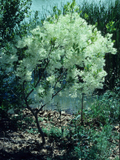
Chionanthus virginicus (white fringetree) has leaves up to 8 inches long. If you are able to purchase a male variety of the tree, you will get showy flowers and no fruit, trusting that the nursery you patronize can determine the sex of the trees they sell. BUT, these trees may grow to 25 to 30 feet high, have high fertility needs and low drought tolerance.
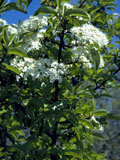
Viburnum prunifolium (blackhaw) and its cousin, Viburnum rufidulum (rusty blackhaw), are strong candidates in terms of hardiness and size, topping out about 16 feet. BUT, the leaves aren't huge (between 1-1/4 and 3-1/4 inches) and the trees produce an edible fruit, enjoyed by birds. While there may be some powdery mildew, there are no serious diseases for the blackhaw.
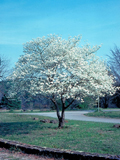
Cornus florida (flowering dogwood) grows to about 20 feet in height, has medium fertility needs and medium drought resistance. It is a beautiful and popular spring bloomer. Birds and squirrels will take care of the fruit for you, BUT it may be susceptible to many plant pathogens. One variant has been specifically adapted for your area and will have the best disease resistance, so if you select this tree, ask for a "Richland" species.
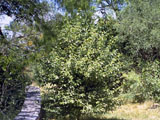
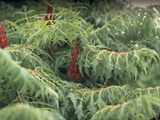
Though it may be an unusual choice, Rhus typhina (staghorn sumac) meets some of your criteria. Often seen in the wild, it is drought tolerant and pest resistant, requiring little nurturing. It grows about 15 feet in height, though some are reported to be up to 30 feet tall. The large fruits are actually quite attractive and usually are not messy. They provide sustenance for a wide variety of birds in the fall and throughout the winter as the fruits do not drop. BUT it may require careful trimming to encourage it to a desired height.
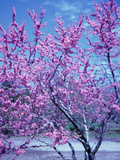
Though the leaves are not large, Cercis canadensis (eastern redbud) may be your strongest candidate. Growing to about 16 feet, it has high drought resistance and low fertility needs. These small trees are Ohio's harbinger of spring when you see their bright pinkish-purple floral display all over Ohio, suggesting they are well adapted to the climate and soil.
Your nursery personnel may also be able to guide you to a suitable selection. Check our Native Plant Suppliers site and enter your city and state to find the suppliers closest to Perrysville.
Check out tree suggestions at two sites: The United States Department of Agriculture and our Native Plant Database. You may find other tree options than the ones we have suggested. The Ohio Department of Natural Resources, Division of Forestry has great information about tree varieties and planting instructions. Thank you for the opportunity to research this information for you.
More Trees Questions
Texas Pistachio trees dropping leaves in Austin
June 09, 2010 - I have several Texas Pistachio that are about 13 years old. Despite good rainfall in Travis county this year, they seem to be losing most of their new leaf growth now in early June. Leaves are simpl...
view the full question and answer
Correction of tree name from Bay Point CA
October 16, 2013 - The tree should of been Mulberry don't know how it was changed!!
Tuesday - October 15, 2013
From: Bay Point, CA
Region: California
Topic: Non-Natives, Cacti and Succulents, Trees
Title: Non-...
view the full question and answer
How far east to avoid Ashe juniper pollen from Austin?
September 04, 2010 - How far East of San Antonio and Austin do I have to go to avoid the pollen of Juniperus Ashei? Is Bastrop county safe? I'd be happy if it were gone 90% of the winter days - will the wind keep it aw...
view the full question and answer
Native Christmas tree from Smithville TX
December 16, 2012 - I've always wanted to use a native tree as a Christmas tree. Do you have any suggestions?
view the full question and answer
When should a redbud start blooming?
March 06, 2009 - Does it take a couple or more years for a redbud tree to bloom? I had some in Houston when I lived there and it seems like it took a long time for them to bloom. I now live in Richards (Near Huntsvill...
view the full question and answer
| Support the Wildflower Center by Donating Online or Becoming a Member today. |