Native Plants

Q. Who is Mr. Smarty Plants?
A: There are those who suspect Wildflower Center volunteers are the culpable and capable culprits. Yet, others think staff members play some, albeit small, role. You can torture us with your plant questions, but we will never reveal the Green Guru's secret identity.

Did you know you can access the Native Plant Information Network with your web-enabled smartphone?

Ask Mr. Smarty Plants
Ask Mr. Smarty Plants is a free service provided by the staff and volunteers at the Lady Bird Johnson Wildflower Center.

rate this answer

Friday - January 02, 2009
From: Franklin, TN
Region: Southeast
Topic: Trees
Title: Tree near a patio in Tennessee
Answered by: Barbara Medford
QUESTION:
What type of tree would you plant near a patio (new home and yard) that gets afternoon sun? ThanksANSWER:
Before we begin to answer your question, let's talk about "near". There has been a great deal of damage done to concrete patios, foundations, sidewalks and tree roots because a "small" tree grew up to be a big tree, with extensive roots. Concrete and paving do not mix well with tree roots; the paving can starve the tree of oxygen or water and the tree roots can crack the paving. We have extracted some material from this Previous answer for someone who needed to pave near existing trees.
"The ground area at the outside edge of the canopy, referred to as the dripline, is especially important. The tree obtains most of its surface water here, and conducts an important exchange of air and other gases. Any change in the level of soil around a tree can have a negative impact. The most critical area lies within 6 to 10 feet of the trunk. No soil should be added or scraped away from that area.
Paving should be kept out of the dripline and no closer than 15 feet from the tree trunk. If at all possible, use a porous paving material such as brick with sand joints, open bricks, bark, gravel, etc., which will allow some water penetration and gas exchange. Even with porous paving, the area around the trunk-at least a 10 foot radius-should be natural and uncovered."
This, of course, was telling them where to put the paving; in your case, you need to decide where to put the tree, since your patio is already there. We will make some suggestions for attractive trees for your patio area, but you will have to make the decision on where to plant your tree based on projected speed of growth and mature size, width of canopy, etc. You didn't say if you wanted shade or attractive foliage and flowers or a privacy shield, so we will pick several trees that would fill one or more of those purposes. We will go to our Recommended Species section, click on Tennessee on the map, which will take us to a list of 121 plants native to Tennessee. Click on NARROW YOUR SEARCH, click on "trees" under Habit, and the Narrow your search box at the bottom of the page. This will give you 52 trees native to Tennessee. Clicking on each scientific name will link you to our webpage on that plant, with more information, and you can go down that page to a link with Google. After you have looked at our list and studied the webpages, you can make your own list, and this time click on Light Requirements and Soil Moisture to match the conditions in your garden.
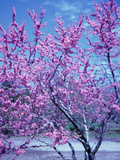
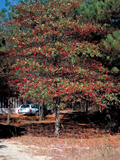
Cercis canadensis (eastern redbud) - 15 to 30 ft. tall, deciduous, blooms pink March to May, attractive foliage and flowers, needs part shade (2-6 hours sun a day) to shade (less than 2 hours of sun a day).
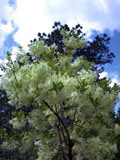
Chionanthus virginicus (white fringetree) - 15 to 30 ft., deciduous, white blooms April to May, part shade
Diospyros virginiana (common persimmon) - 36 to 72 ft., deciduous, orange edible fruit attracts wildlife
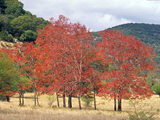
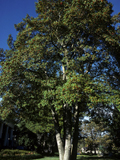
Fagus grandifolia (American beech) - 50 to 80 ft., fall color persistant into winter, good shade tree, bears edible beechnuts, important food for wildlife
Ilex opaca (American holly) - 25 to 60 ft., evergreen, bright red berries on females, must be a male within 30 to 40 feet for production of berries, attracts songbirds, slow growing
Nyssa sylvatica (blackgum) - 30 to 60 ft., falll color, shade and ornamental, honey plant, fruit consumed by birds and mammals
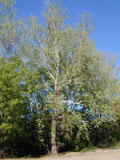
Platanus occidentalis (American sycamore) - 75 to 100 ft., deciduous, wide canopy, shade tree, attractive bark
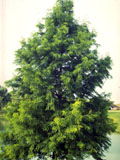
Taxodium distichum (bald cypress) - 50 to 75 ft., exfoliating red-brown to silver bark, deciduous conifer

More Trees Questions
Why is non-native peach tree not going dormant in Owensville IN
December 19, 2011 - I have a peach tree I grew from a peach pit. It is about 2 years old. I planted the tree in my yard this summer. It is now about 3' tall. My problem is it is not going dormant. We have had several fr...
view the full question and answer
Soapberry Transplant shock symptoms
July 21, 2006 - Please suggest a cause & cure for general yellowing of the leaves of Western Soapberry when planted in the ground 20 miles NW of Austin (thin, poor clay over limestone). Trees still in containers are...
view the full question and answer
Viability of Texas madrone tree in Weatherford, TX
September 27, 2005 - I live in Weatherford, Texas (Parker County). Will a Madrone tree make it ok here and who sells them?
view the full question and answer
Native Texas tree for anniversary in Austin
May 20, 2009 - My husband and I would like to plant a tree in our yard commemorating our 5 year anniversary (wood anniversary). What native Texas tree can we plant in June? I love Red buds and any pretty blooming ...
view the full question and answer
Using Coffee Grounds under Live Oaks in Texas?
March 18, 2016 - Can you add coffee grounds to live oak tree?
view the full question and answer
| Support the Wildflower Center by Donating Online or Becoming a Member today. |