Native Plants

Q. Who is Mr. Smarty Plants?
A: There are those who suspect Wildflower Center volunteers are the culpable and capable culprits. Yet, others think staff members play some, albeit small, role. You can torture us with your plant questions, but we will never reveal the Green Guru's secret identity.

Did you know you can access the Native Plant Information Network with your web-enabled smartphone?

Ask Mr. Smarty Plants
Ask Mr. Smarty Plants is a free service provided by the staff and volunteers at the Lady Bird Johnson Wildflower Center.

rate this answer

Tuesday - December 16, 2008
From: Hawthorn Woods, IL
Region: Midwest
Topic: Privacy Screening
Title: Screening plants for edge of pond in Illinois
Answered by: Barbara Medford
QUESTION:
I have a backyard pond that I am restoring, adding aeration, plants, etc. Unfortunately, there is a farmer that stores old equipment on the shore of my pond and refuses to move it. It is an eyesore. Are there any perennial plants (Zone 5) that will grow tall in water and screen out some of this? I don't want it to overrun the pond though. Any suggestions would be appreciated. Thank you.ANSWER:
When you say the unwelcome equipment is at the shore of your pond, how close is that? Is the edge of your pond on your property and the farm equipment on his? There are plants that will grow in water in Zone 5, native to Illinois, that will provide some screening, and we will list them for you. There are also Illinois native trees and shrubs that don't grow IN water, but can grow in soggy soil at the edge of ponds or rivers, and would provide better screening still, but they would need some ground, maybe ten feet or so between the edge of your pond and the equipment. Unfortunately, none of these are evergreen, but at least they will help. To begin with the water plants:
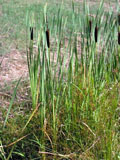
Typha latifolia (broadleaf cattail) This perennial grows from 4 to 8 feet tall, with creeping rootstocks that form dense stands in shallow water, so it might be advisable to plant it in a large container underwater to prevent the pond being taken over by cattails.
Equisetum hyemale (scouringrush horsetail) Perennial growing in wet places, pond margins, swamps, to 3 feet tall.
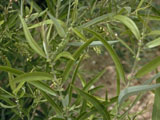
For the area beyond the pond, if there is room, you could consider some willows, members of the Salix genus. Willows are fast-growing, but can be weak and susceptible to disease. They should be trimmed back vigorously every few years to encourage stronger growth. Perhaps by the time they need to be replaced or removed, the farm equipment will have rusted away.
Salix caroliniana (coastal plain willow) Grows in wet soils of stream banks or swamps.
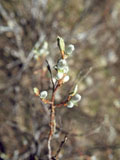
Salix discolor (pussy willow) Many-stemmed shrub or small tree, marshy low ground, stream banks.
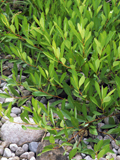
Salix humilis (prairie willow) Alluvial or boggy areas, 6 to 12 feet tall.
And some plants that will do well in soggy ground, and provide even more screening.
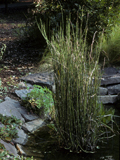
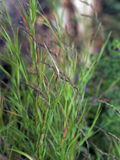
Spartina pectinata (prairie cordgrass) Rigid, upright perennial that grows well in low, wet areas, marshes.
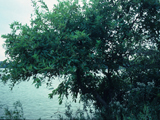
Cephalanthus occidentalis (common buttonbush) Found in swamps and around ponds and margins of streams.
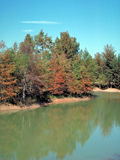
Taxodium distichum (bald cypress) Adapted to moist habitats, provides some height and interest.
Follow each plant link to a webpage on that plant, and go down to the bottom of the page and use the link to Google to get more information. These plants should all be commercially available. If you don't find them readily available in your area, go to our Native Plant Suppliers, type your town and state into the "Enter Search Location" box and you will get a list of native plant nurseries, seed companies and landscape consultants in your general area.
More Privacy Screening Questions
Evergreen sumacs for privacy along fence
August 02, 2014 - I would like to plant enough Evergreen Sumacs along our fence for privacy for the length of our backyard which is 60 ft. Fifteen feet on the left and right ends are shaded with the right side being d...
view the full question and answer
Need plants for privacy screening in a campground in Wade, NC.
December 14, 2010 - Landscaping a campground tent area, need evergreen to grow to ground, narrow in width but will reach height for privacy. There is a wooded tree line along wall that produces shade during summer. Any...
view the full question and answer
Deer resistant screening evergreens for CT
April 07, 2010 - I live in Connecticut, in a predominantly wooded environment. I am looking for a recommendation for a great screening tree, which I can use to block a view of Neighbors behind me. It would need to b...
view the full question and answer
Fast-growing non-invasive shrub for privacy fence in Sugar Land TX
December 06, 2011 - I live in South Texas in Sugar Land. I was going to plant oleanders in my backyard along the fence as a privacy hedge, about 20 feet from my house. However, I was told they were a bad choice becaus...
view the full question and answer
Dog and kid barrier in East Wenatchee WA
October 01, 2009 - I have about a 8 foot section between my driveway and the neighbor's yard, and their kids and dogs like to run through it! I would like to plant a non-invasive 4-6 foot growing shrub/bush of some s...
view the full question and answer
| Support the Wildflower Center by Donating Online or Becoming a Member today. |