Native Plants

Q. Who is Mr. Smarty Plants?
A: There are those who suspect Wildflower Center volunteers are the culpable and capable culprits. Yet, others think staff members play some, albeit small, role. You can torture us with your plant questions, but we will never reveal the Green Guru's secret identity.
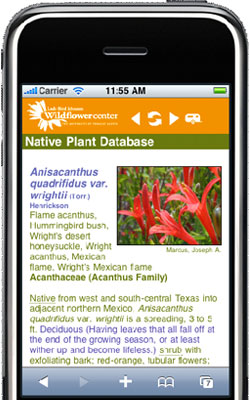
Did you know you can access the Native Plant Information Network with your web-enabled smartphone?

Ask Mr. Smarty Plants
Ask Mr. Smarty Plants is a free service provided by the staff and volunteers at the Lady Bird Johnson Wildflower Center.

rate this answer

Sunday - September 28, 2008
From: Pearland, TX
Region: Southwest
Topic: Trees
Title: Selection of native trees to replace trees lost in hurricane
Answered by: Barbara Medford
QUESTION:
Hello, I have a tree replacement list I must choose from as I live in a HOA deeded area. I lost 2 pines to the hurricane. And according to them I need to replace with 2 large trees. The pines were 15 feet from my front foundation; my front lawn is at 30 feet when you get to the sidewalk. My width is 60 feet. I get sun all day in the front. Here is the list: live oak tree, Shumard red oak tree, Nuttall oak tree, Laurel oak tree, Drummond Maple tree. I live in Pearland, Texas just outside of Houston. Which would you choose? Note: I would prefer a Mimosa and not a large tree but they won't approve it, and also they seem fixated on 2 trees. Please advise me.ANSWER:
First, let's talk about Albizia julibrissin, Mimosa. We would not recommend this tree anyway, because it is non-native to North America. The Lady Bird Johnson Wildflower Center supports the use, protection and propagation of plants native to North America and to the area in which they are being grown, because they will need less water, fertilizer and maintenance. Furthermore, we can understand the HOA's dislike for the Mimosa-it is a weak-wooded, short-lived tree, considered an invasive weed, and actually outlawed in many urban areas because of its tendency to spread into and take over other areas.
Next, your preference for a small tree. All of the oaks and maples are going to grow up and be big trees. However, they are generally moderate growers, and you might not still be living in your house when one of them gets to 100 feet tall. In order to be transplanted at all, they are going to have to begin small. Most oaks have a taproot, which is very difficult to transplant and if the root is damaged, the tree may not survive.
Now, on to the trees on your list. For the Live Oak, we found two, Quercus virginiana (live oak) and Quercus fusiformis (plateau oak), both of which are native to Texas, both with the common name "Live Oak". However, we eliminated Quercus fusiformis (plateau oak) from the running, because all of the other trees, including Quercus virginiana (live oak), tolerate wet soil, and are considered more adaptable to the Gulf Coast. We think that is probably why your HOA selected those particular trees, because of the area in which Pearland is located.
The Nuttall Oak, we could not find by that name in our Native Plant Database. That doesn't mean it doesn't exist, it just means our database doesn't recognize that name. Retailers will often name plants something that is not recognized as a botanical nor a common name, which can be confusing. We did, however, find information on that oak.
Quercus virginiana (live oak)- also called Coastal Oak, found on the Southeastern Texas coast. Matures into a massive, wide-spreading tree 40 to 80 ft. in height, and 60 to 100 feet in width. Young trees grow quickly and need to be trained if their natural tendency to spread is unwelcome. Susceptible, among other things, to oak wilt and chestnut blight. Fast-growing under optimal conditions, but growth rates taper off as age increases, life measured in centuries. While not totally evergreen, this tree sheds most of its leaves in Spring, to be replaced in weeks by new growth.
Quercus shumardii (Shumard's oak) - pyrimidal, growing 50 to 90 ft. in height, and 50 to 60 ft. spread. Deciduous, with good Fall color. Considered very susceptible to oak wilt.
Quercus nuttallii (USDA Forest Service), Nuttall oak tree - 60 to 80 ft. tall, 30 to 50 ft. spread. Pictures.
Quercus hemisphaerica (Darlington oak) - also called a Laurel Oak - growth rate moderate to rapid, height 40 ft. to 60 ft., width 30 ft. to 40 ft. Pictures.
Acer rubrum var. drummondii (Drummond's maple) - tree of wet habitats, 72 to 100 ft. tall, deciduous, Fall color. Pictures.
It sounds like your HOA is trying to replace trees felled by the hurricane with trees that are sturdier and more wind-resistant.


More Trees Questions
Bald cypress causing problems in Spring TX
June 22, 2010 - There is a 50+ ft Bald Cypress growing near my property line. While the tree has grown substantial knees along the driveway and some as far as 35 ft from the tree in my flower beds, I do not see any d...
view the full question and answer
Low maintenance replacement garden in Ashburn , VA
April 30, 2009 - We live in Ashburn, VA (Northern VA). Our house is 10 years old and the contractor grade plants have died. We are planning on digging everything up and re-doing the landscaping in our front yard - r...
view the full question and answer
Oak saplings in Boerne TX
August 02, 2010 - Is there anything I can do to kill the oak tree saplings that come up around my oak tree? I have a nice raised flower bed around the tree and now it's full of these saplings.
Thanks for your help...
view the full question and answer
Possibility of saving hurricane-damaged Umbrella Magnolia
October 12, 2005 - Our beautiful umbrella magnolia Magnoliaceae Magnolia tripetala was toppled during Hurricane Katrina. We have lifted it back in place, however it looks very distressed. I have the following questions:...
view the full question and answer
Evergreen for inland San Diego, California
November 28, 2009 - I'm looking for an evergreen tree for my inland San Diego residence, 30 foot max height, growth speed is not important. I had decided on the carrotwood until I found your site and discovered the prob...
view the full question and answer
| Support the Wildflower Center by Donating Online or Becoming a Member today. |