Native Plants

Q. Who is Mr. Smarty Plants?
A: There are those who suspect Wildflower Center volunteers are the culpable and capable culprits. Yet, others think staff members play some, albeit small, role. You can torture us with your plant questions, but we will never reveal the Green Guru's secret identity.

Did you know you can access the Native Plant Information Network with your web-enabled smartphone?

Ask Mr. Smarty Plants
Ask Mr. Smarty Plants is a free service provided by the staff and volunteers at the Lady Bird Johnson Wildflower Center.

rate this answer

Wednesday - July 22, 2009
From: Baltimore, MD
Region: Mid-Atlantic
Topic: Rain Gardens, Compost and Mulch, Grasses or Grass-like
Title: Native plants for a bioswale in Baltimore
Answered by: Barbara Medford
QUESTION:
What native plants would suit a bioswale in an urban part of Baltimore City? The clay soil gets waterlogged and the site has part shade.ANSWER:
Mr. Smarty Plants is not THAT smart, and can always learn something new. This time we learned about bioswales. Common swales are typically vegetated with turf grass and are a conveyance tool, basically a grassy stormwater sewer that conveys water as quickly as possible from Point A to Point B. A bioswale differs in that the turf grass is replaced with native prairie vegetation. This will significantly reduce the flow velocity (slow down of the runoff) in the swale’s drainage course. The residence time of the runoff is thus increased, which gives it the time to be stored, filtered, and infiltrated. These processes remove pollutants and suspended solids from runoff.
In terms of your clay soil, we found this information on bioswale construction from the USDA, which shows compost tilled into the native soil (clay, in this instance) to facilitate the drainage. The plants we have selected are all perennial, tolerate shade, and will grow in moist, clay soils. These are plants with fibrous roots that will hold in the soil when water is rushing by, help to slow it down, and permit the pollutants in the water to be filtered out.
Since our suggestions are basically for prairie grasses, you might be interested in reading our How-To Article Recreating a Prairie, which has instructions for time of year to be planting, preparing the soil, planting and caring for the grasses. When you are ready to begin, go to our Native Plant Suppliers section, put your town and state in the Enter Search Location box, and you will get a list of native plant nurseries, seed companies and landscape consultants in your general area who can help you select the right plants for your purpose.
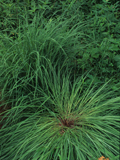
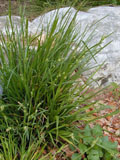
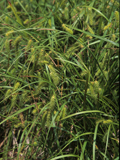
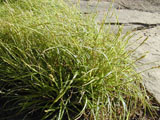
Andropogon gerardii (big bluestem)
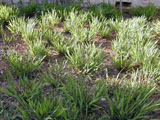
Carex blanda (eastern woodland sedge)
Carex hystericina (bottlebrush sedge)
Chasmanthium latifolium (Inland sea oats)
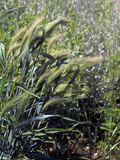
Elymus canadensis (Canada wildrye)
Elymus virginicus (Virginia wildrye)
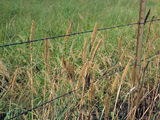
Sorghastrum nutans (Indiangrass)

More Compost and Mulch Questions
Native grass lawn for San Antonio
June 25, 2011 - Dear Mr Smartyplants, I live outside of San Antonio and my question is in regards to putting in a native grass lawn. What type of soil should I put down? I've sprayed herbicide and was planning on ...
view the full question and answer
Using Horse Manure for the Garden
July 07, 2016 - Can you use horse manure for decomposed matter for your flower beds, etc.?
view the full question and answer
Planting Anacacho orchid tree in Llano, TX
October 05, 2011 - Re Bauhinia lunarioides:
I'm trying to pick a good site in Llano Co for a 5 gal tree I received as a gift. Your plant database says part shade. The arid zone trees publication you reference in a...
view the full question and answer
Too late to begin planting in May in Austin?
April 30, 2008 - Is it too late to begin planting in May? I live in Austin Texas and have finally completed my plans for a native Texas landscaping (plants and grass) of my front yard. I'd like to get the landscapi...
view the full question and answer
Fertilizer amounts for native perennials in Belton, TX
March 18, 2009 - I am a novice gardener and need advice on how to fertilize my native perennials. I would like to use organic fertilizer and need advice on exactly what to use. I have a compost pile but it does not ...
view the full question and answer
| Support the Wildflower Center by Donating Online or Becoming a Member today. |