Native Plants

Q. Who is Mr. Smarty Plants?
A: There are those who suspect Wildflower Center volunteers are the culpable and capable culprits. Yet, others think staff members play some, albeit small, role. You can torture us with your plant questions, but we will never reveal the Green Guru's secret identity.

Did you know you can access the Native Plant Information Network with your web-enabled smartphone?

Ask Mr. Smarty Plants
Ask Mr. Smarty Plants is a free service provided by the staff and volunteers at the Lady Bird Johnson Wildflower Center.

rate this answer

Tuesday - August 26, 2008
From: Philadelphia, PA
Region: Mid-Atlantic
Topic: Transplants, Herbs/Forbs
Title: Dying blackeyed Susans in new garden in Pennsylvania
Answered by: Barbara Medford
QUESTION:
Hi Mr. Smarty Plants! I have recently planted black eyed susans in a newly dug garden along with some cone flowers. The other flowers are doing fine but the black eyed susans have all dried up and are dying. I water them every other morning, and they get full sun with the exception of some shade in the early morning. I don't see any disease or evidence of being eaten by bugs on them. What could be causing them to die? Please help a new and eager to learn gardener.ANSWER:
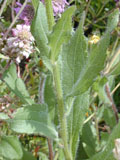
Rudbeckia hirta (blackeyed Susan is a hearty plant, native to Pennsylvania (as well as most of the rest of the U.S.) and should not be acting like that. We will throw out some possibilities, and perhaps you can decide if you want to keep the plants or give them up. First, since they were recently planted, it could be transplant shock. Ordinarily, we recommend that you plant bedding plants (which is what we are assuming you have) in the Spring, rather than in the hotter parts of summer. If the plants had already been on the nursery tables for several weeks, they could have been root-bound, or just dried out and not very viable. Often, plants sold in nurseries are artificially forced into bloom to make them more attractive to buyers, and later they will droop or wilt. About the best help we can offer you is to treat them for transplant shock. Trim off about the upper 1/4 to 1/3 of the plant, especially removing the dying or dead leaves, but trying to leave as many green leaves, for nutrition, as possible. Next, since it is Summer, and you say they are in full sun just about all day, put a light mulch, preferably an organic mulch of compost or shredded bark over their roots. Don't pile it against the plant stems, that will just encourage molds. Then, try giving it a slow gentle watering, not from above if possible, about twice a week. Don't fertilize, you never should fertilize a plant under stress. The blackeyed Susan is considered an annual to a short-lived perennial, so don't fret too much if they don't make it. See the propagation instructions on the webpage linked above; you might want to consider planting seeds in the Fall, rather than buying bedding plants in the Spring.



More Transplants Questions
Need help with century plant in Willis, TX
September 21, 2014 - Ok so I have two gorgeously monstrous century plants in my yard..I love em BUT I don't know if the have ever bloomed but since I am removing pups as fast as I can during the rainy season I'm assumin...
view the full question and answer
Madrone too close to house in Oregon
February 02, 2009 - I have a small Madrone tree (8ft tall) located approximatly 15 feet from my house, with a basement.
Should I remove it? ie will it damage the foundation and is the tree strong enough that it will no...
view the full question and answer
Twisted hibiscus tree in Plainfield, IN
April 24, 2009 - I have just bought 4 twisted hibiscus trees and repotted them immediately then brought them into my screened in porch until I was certain the weather would be safe to keep them outside (I live in Cent...
view the full question and answer
Laurel oak tree not leafing out in Pasadena TX
April 13, 2010 - Hurricane Ike blew down our red bud in the backyard. Had a large 25' laurel oak planted early March 2010. When it was put in the ground, the leaves were on it, but they were all brown and dried. T...
view the full question and answer
Failure to thrive of Cherokee sedge in Spicewood, TX
May 18, 2009 - I have several Cherokee sedges, just planted in March. Three of them are doing fine, but the rest look like they're dying. Some are right next to one that is doing great. Any ideas?
view the full question and answer
| Support the Wildflower Center by Donating Online or Becoming a Member today. |