Native Plants

Q. Who is Mr. Smarty Plants?
A: There are those who suspect Wildflower Center volunteers are the culpable and capable culprits. Yet, others think staff members play some, albeit small, role. You can torture us with your plant questions, but we will never reveal the Green Guru's secret identity.

Did you know you can access the Native Plant Information Network with your web-enabled smartphone?

Ask Mr. Smarty Plants
Ask Mr. Smarty Plants is a free service provided by the staff and volunteers at the Lady Bird Johnson Wildflower Center.

rate this answer

Sunday - May 25, 2008
From: Denver, CO
Region: Rocky Mountain
Topic: Propagation
Title: Planting time for California poppies in Colorado
Answered by: Barbara Medford
QUESTION:
I live in Colorado and planted California Poppies in my front yard at the end of April. I read that I probably should have planted them in the fall. There have sprouted a little but they don't seem to be nearing a bloom. Will I still get blooms this year? If so, when?ANSWER:
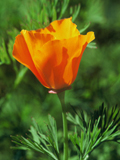
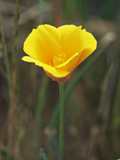
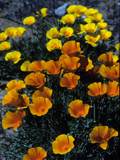
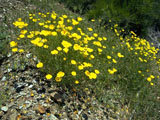
Eschscholzia californica (California poppy) is a native of California, but has spread to most of the country. It is found naturally in grassy and open areas from sea level to 6500 ft. so it should be okay in Denver. This species is said to be a “drought escaper” because it lies dormant as seed for what might be years in some areas. When a good rain comes, seeds rapidly take root and flower. Individual populations have adapted to their particular local conditions. In the native range, where it is dry or there are cold hard winters, this species is an annual (living only one year and then reseeding). Outside of these areas, plants develop a tap root, for energy storage, and live beyond a year. Probably where you are, these poppies would be treated as annuals, but they readily reseed. In natural conditions, Eschscholzia californica (California poppy) blooms most heavily from March to May, but with supplemental watering that can be extended. The webpage lists bloom time as February to October. The propagation instructions on our webpage for this species says seeding should be in the Fall, where the plants are to grow, as they do not transplant well. Since you planted your seeds right in the middle of their normal blooming period, you probably will not get much, if anything, in the way of blooms this year. However, you notice that the seeds can stay alive in the soil through a cold winter, so some of the seeds you planted may very well show up as blooming plants next year. With good conditions, some of your seedlings might get big enough to bloom this year, because the urge to reproduce is very strong, and they need to flower in order to set seed. You have the option of hoping that will happen and, also, that some of the dormant seeds will come up next year, as well as to plant more seeds this Fall.
More Propagation Questions
Bulbils on Turks cap lily
July 21, 2005 - My Turks cap lily has dark pea size growths at the bass of each leaf. Are these the seeds? How and when do I harvest seeds from this plant?
view the full question and answer
Propagation of yellow columbine
November 03, 2004 - I purchased a yellow columbine, Aquilegia chrysantha and your website says it grows in moist upland soils, and yet it shows their habitat as Utah, Arizona, NM, and sw Texas. Tell me how it can...
view the full question and answer
Why is my Horstail falling over in Austin?
October 14, 2010 - I have a Horsetail plant. It was doing great but now, for the last few months, its not growing straight! Its falling over. Why?
view the full question and answer
How to propagate Texas red buckeye (Aesculus sp.) from seeds
May 01, 2007 - I have a Texas Red Buckeye that is doing very well. How do I propagate from the seeds that come off of that tree? Thanks,
view the full question and answer
Propagating Eustoma exaltatum from seed in Lucas TX
September 27, 2010 - Hello
I know that Texas bluebells Eustoma exaltatum ssp. russellianum are supposed to be difficult to start from seed.
Does Mr. Smarty Plants have any helpful hints?
Thanks!
view the full question and answer
| Support the Wildflower Center by Donating Online or Becoming a Member today. |