Native Plants

Q. Who is Mr. Smarty Plants?
A: There are those who suspect Wildflower Center volunteers are the culpable and capable culprits. Yet, others think staff members play some, albeit small, role. You can torture us with your plant questions, but we will never reveal the Green Guru's secret identity.

Did you know you can access the Native Plant Information Network with your web-enabled smartphone?

Ask Mr. Smarty Plants
Ask Mr. Smarty Plants is a free service provided by the staff and volunteers at the Lady Bird Johnson Wildflower Center.

rate this answer

Tuesday - April 22, 2008
From: Austin, TX
Region: Southwest
Topic: Poisonous Plants
Title: Dealing with poison ivy
Answered by: Barbara Medford
QUESTION:
Suggestions for eradicating Poison Ivy? I have just a small growth in my backyard. Thanks -ANSWER:
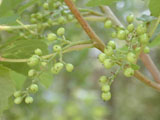
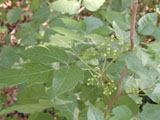
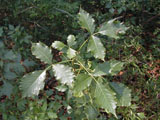
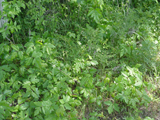
Eradicating? Isn't going to happen. Controlling? Yes, you can do that, but it's not a one-off operation. Toxicodendron radicans (eastern poison ivy) is easily and continuously spread by birds, who like the berries. They eat the berry, it's processed through their digestive system, and they return it to the earth with some fresh fertilizer, no charge. Poison ivy is very good at camouflage and disguise, as well. It needs shade and moisture, so what better place than under an ornamental bush or tree that you are watering and caring for? It can climb trees, concealing its stems in the bark, with dark green leaves that blend right in. You really can't risk using an herbicide, because there's no way to keep from zapping the ornamentals you have painstakingly planted. Some gardeners have tried "painting" a few leaves with herbicide, but this is still pretty chancy.
So, here is our recommendation. You'll need rubber gloves (like you use for dishwashing) and paper towels or newspaper, plus a plastic trash bag for disposal. Scout out the roots, and with gloves on and a piece of paper towel wrapped around the roots try to pull it all out. As you pull it out, keep the stems away from you, wrap it in paper and put it in the plastic bag. We have heard that washing skin that has been exposed to poison ivy, very quickly, in dishwashing soap will help. What we do is wash our hands, with the rubber gloves still on, in the dishwashing liquid. If you feel your clothes have come in contact with the poison ivy, take them off very gingerly, trying not to touch any of the oils from the ivy, and get them straight into the washing machine. This may sound very elaborate, but anyone who has ever had poison ivy dermatitis will tell you it's worth it.
Toxicodendron radicans (eastern poison ivy) is deciduous, but even dormant plant material can cause problems if it's touched. The best time to attack it is in the early Spring, when the whole plant should be easier to get out. It takes many different forms, although the rule of "leaves of three, let them be" still applies.
More Poisonous Plants Questions
What tree berries causes blisters in PA?
July 22, 2009 - This summer my family was playing with some berries picked from a tree in our backyard. They would place them in their mouths and shoot them through homemade pea-shooters. Shortly after everyone beg...
view the full question and answer
California plants poisonous to dogs from Sacramento
July 01, 2012 - Found dodonea viscosa purple. Is it poisonous to dogs? Also Gold Star Potentilla.
Going drought tolerant and need small trees, shrubs and plants not poisonous to dogs for sun and partial sun.
view the full question and answer
Plants referred to as Hummingbird plants
August 22, 2008 - We have a a plant that is sometimes called a Hummingbird Plant, sometimes a Firecracker plant. I have also seen the name lonicera sempervirens. Are they poisonous? This is a plant, not a vine.
T...
view the full question and answer
Non-Toxic Hedge for Wisconsin
December 17, 2015 - What would be a good non-toxic for dogs, privacy hedge about 3-6 feet tall for Wisconsin climate zone 4b?
view the full question and answer
Alpacas poisoned in pasture in Texas
October 26, 2008 - Two of my alpacas were poisoned by something growing in two of my pastures. One of the suspects is cussus trifoliata, aka, cow itch vine, sorrelvine. I have searched diligently and can find no refere...
view the full question and answer
| Support the Wildflower Center by Donating Online or Becoming a Member today. |