Native Plants
Q. Who is Mr. Smarty Plants?
A: There are those who suspect Wildflower Center volunteers are the culpable and capable culprits. Yet, others think staff members play some, albeit small, role. You can torture us with your plant questions, but we will never reveal the Green Guru's secret identity.
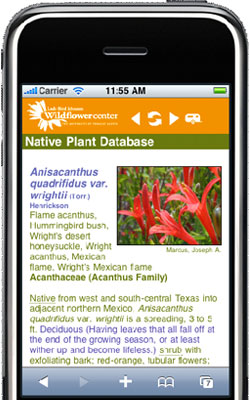
Did you know you can access the Native Plant Information Network with your web-enabled smartphone?

Ask Mr. Smarty Plants
Ask Mr. Smarty Plants is a free service provided by the staff and volunteers at the Lady Bird Johnson Wildflower Center.
rate this answer

Thursday - April 17, 2008
From: Baltimore, MD
Region: Mid-Atlantic
Topic: Pollinators, Propagation, Shrubs
Title: Failure of hybridized red hollies to grow
Answered by: Barbara Medford
QUESTION:
I have 2 red hollies planted in my yard about 20' apart, 3 years now. They won't grow. Do I need to have a male with them?ANSWER:
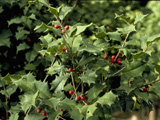
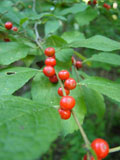
The native North American members of the genus Ilex (holly) that will grow in the Baltimore area are Ilex decidua (possumhaw), Ilex opaca (American holly), and Ilex verticillata (common winterberry). None of those seemed to be the "Red Holly" you were referring to, but we discovered that there a number of cultivars that have been hybridized from the native hollies that have come to be called red hollies. Here is an article from the Mississippi State Office of Agricultural Communication on Red Holly. When you have a hybridized plant, that makes it a little difficult to determine what its normal growing habit would be, so we really don't know why your hollies are not growing as you expected. We can tell you, however, that it has nothing to do with the gender of the plants. The gender of the plants comes into play when you are seeking to have berries on your hollies. Only the females produce berries, and there will be no or very few berries if there is not a male pollinator in the area. The standard wisdom on that is that there should be one male plant (of the appropriate flowering time) in close proximity to three to five female plants, to ensure good pollination and fruit set.
But to get back to your original question, why are your hollies not growing? Since they are no doubt hybrids of a native Ilex, cultural requirements should not be that different. If you will follow the plant links above to the descriptive webpages from our Native Plant Database, you will learn that the holly is a very slow-growing plant. They also prefer moist, well-drained soils, and are tolerant of shade. It looks like the prescription is for patience. If you don't see any obvious indications of insect or disease problems, it's likely that the hollies are just taking their sweet time getting adjusted to the conditions in your garden, and will grow when they're ready.
More Shrubs Questions
Foundation garden in shade in Durham, NC
April 29, 2009 - I'm trying to replant a 3'x8' garden near the foundation of our house in Durham, NC. This part of the yard gets little, if any, sun and is mostly clay. I've tried adding compost and soil conditi...
view the full question and answer
Identification of thorny shrub with blue berries
May 24, 2011 - Thorny shrub with blue berries. In our acid sandy loam we have many thorn bushes. This one has small leaves like a wild pomegranate, long thorns. berries of the size and color of blueberries and is ...
view the full question and answer
Evergreen shrub for northwest-facing wall
June 09, 2012 - Can you suggest a tall (8-10') evergreen shrub for a site against a northwest-facing wall which gets no sun in the winter but full sun in the summer? Texas sage got too leggy and viburnum will be to...
view the full question and answer
Texas native plants for cemetery site
February 09, 2005 - I am trying to landscape my mothers gravesite located in far East Texas (just outside of Nacogdoches) and I am looking for some evergreen bushes or any other decorative plants for that area. I am thi...
view the full question and answer
Identification of lantanas safe for use in Florida
February 10, 2008 - Why do you list lantana camara as a native to the U.S. and as a native plant in Florida? It is a category one invasive exotic on the Florida Exotic Pest Plant Council's list of invasive exotics. La...
view the full question and answer
| Support the Wildflower Center by Donating Online or Becoming a Member today. |