Native Plants

Q. Who is Mr. Smarty Plants?
A: There are those who suspect Wildflower Center volunteers are the culpable and capable culprits. Yet, others think staff members play some, albeit small, role. You can torture us with your plant questions, but we will never reveal the Green Guru's secret identity.

Did you know you can access the Native Plant Information Network with your web-enabled smartphone?

Ask Mr. Smarty Plants
Ask Mr. Smarty Plants is a free service provided by the staff and volunteers at the Lady Bird Johnson Wildflower Center.

rate this answer

Thursday - April 10, 2008
From: Rigby, ID
Region: Rocky Mountain
Topic: Poisonous Plants
Title: Fast growing trees in Idaho
Answered by: Barbara Medford
QUESTION:
I want to plant fast-growing trees on my property in Idaho. What trees are poisonous to horses and dogs? I am particularly interested in the Royal Empress (Paulowmia) tree and the dogwood tree.ANSWER:
We don't like to start out with discouraging words, but Paulownia tomentosa is NOT a good choice. We have been asked about it several times, and would like for you to read a previous answer from Mr. Smarty Plants on the subject. Next, read this site from the Plant Conservation Alliance "Least Wanted" List. It appears that some have already escaped cultivation and invaded Idaho; but, under the circumstances, we certainly hope you do not contribute to the problem. The tree is a native of China and, as such, is not normally in the purview of the Lady Bird Johnson Wildflower Center. Our focus and concentration is on plants native to North America; however, we are very interested in invasive plants, especially non-native invasives.
Now, on to the dogwoods, genus Cornus. We found fourteen species of Cornus on our Native Plant Database, of which four can apparently be grown in Idaho.
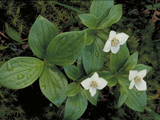
Cornus canadensis (bunchberry dogwood) This is really a low-growing groundcover type of bush, probably not what you had in mind.
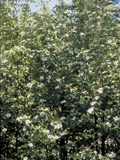
Cornus nuttallii (Pacific dogwood) This USDA Plants Profile shows the areas in Idaho where this species is growing naturally. It is a deciduous tree up to 40 feet tall that does best between 3000 and 8000 feet in altitude. Unfortunately, it is very susceptible to dogwood anthracnose, which has killed many larger plants in the wild and also restricts its use as an ornamental tree.
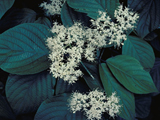
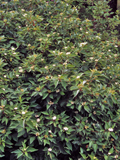
Cornus sericea (redosier dogwood) Both of these sericea dogwoods are recommended for Idaho, and are useful for erosion control.
Cornus sericea ssp. sericea (redosier dogwood)
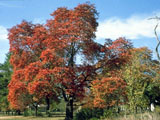
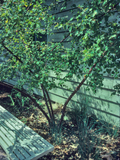
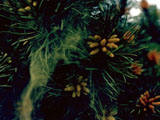
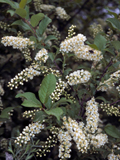
Since none of these seem to be the perfect choice, how about some alternatives? First, for the Empress Tree. We went to our Invasives website and found four alternatives to this tree; unfortunately, none of them are recommended for Idaho. So, we went shopping in the Recommended Species for Idaho section and have four tree suggestions. We realize that you wanted fast-growing, blooming trees, but it may be that is not going to happen in Idaho.
Acer grandidentatum (bigtooth maple)
Betula occidentalis (water birch)
Pinus contorta (lodgepole pine)
Prunus virginiana (chokecherry)
And, finally, your question about what trees are poisonous to horses and dogs. Rather than reproduce the list, let us refer you to this Poisonous Plants Informational Database from Cornell University.
More Poisonous Plants Questions
Toxicity of seeds of Texas Mountain Laurel for dog
April 07, 2007 - I have a Tx Mountain Laurel that is in 1 end of a dog pen. I just heard the seeds are poisonous. Is this true & should we pull the seeds off so the dog can't reach them to eat? Thanks for your assist...
view the full question and answer
Plants for dog-safe privacy hedge in Missouri
July 03, 2006 - I live in Missouri and would like to put a "living fence" around my yard for some privacy. Ideally, I want something that is going to grow fast so that I don't have to wait years and years for my ...
view the full question and answer
Privacy shrubs and trees that are safe for horses in California
June 16, 2012 - What type of privacy shrubs/trees can I plant that are safe around horses? I live in the central valley in CA. Thank you!
view the full question and answer
Fruit and nut trees safe for horses.
May 11, 2015 - My husband and I just moved to Elgin. We have always wanted to grow fruit/nut baring trees but didn't take in to consideration that horses might eat them. We have never had land or horses before, s...
view the full question and answer
Recognizing poison ivy
June 20, 2007 - I am having a difficult time identifying poison ivy. It seems so many plants look like poison ivy can you help me I don't want to kill everything but on the same hand I don't want to itch.
Thanks f...
view the full question and answer
| Support the Wildflower Center by Donating Online or Becoming a Member today. |