Native Plants

Q. Who is Mr. Smarty Plants?
A: There are those who suspect Wildflower Center volunteers are the culpable and capable culprits. Yet, others think staff members play some, albeit small, role. You can torture us with your plant questions, but we will never reveal the Green Guru's secret identity.

Did you know you can access the Native Plant Information Network with your web-enabled smartphone?

Ask Mr. Smarty Plants
Ask Mr. Smarty Plants is a free service provided by the staff and volunteers at the Lady Bird Johnson Wildflower Center.

rate this answer

Saturday - March 22, 2008
From: Garland, TX
Region: Southwest
Topic: Compost and Mulch, Groundcovers, Shade Tolerant, Turf
Title: Pros and cons of Hydrocotyl bonariensis as lawn replacement
Answered by: Barbara Medford
QUESTION:
Want to convert lawn TO dollar weed! My Garland TX yard has become so shady over the years that I have a hard time with grass. A few years ago I noticed dollar weed in the grass which seemed to create an 'under carpet'. I have left it, and it seems to be taking over the shady parts of my yard - and I like it, but the plant gets only bad press. It doesn't seem to need watering or mowing, it stays lower than the lawn mower's blades, the round leaves are really pleasant...like violet leaves... its easy to walk on, it grows between the flag stone that I am increasingly laying where grass no longer grows, AND its a NATIVE plant! Can you tell me anything about the plant - how thickly will it grow? Is there any place to GET seeds to help increase the thickness of the coverage? How is it propagated? via roots or seeds? Why is it so despised?ANSWER:
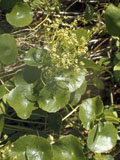
Well, guess what? Hydrocotyle bonariensis (largeleaf pennywort), which is probably the one you have, seems like a nice, natural lawn replacement where there is too much shade and moisture. In fact, as we looked through references to this plant, it seemed that many, if not most, of the sites knocking dollarweed were sponsored by herbicide manufacturers. Go to this site emilycompost and get some positive feedback. If you call it "pennywort", which is another common name, you'll find there is a lot less negative comment about it. Another native plant, Dichondra recurvata (oakwoods ponysfoot), looks very similar but is not related. Dichondra is widely used, especially in California, as a lawn plant. It's very ironic that you are probably replacing one of two invasive, non-native grasses-St. Augustine and Bermuda-with a native, attractive, low maintenance ground cover.
In terms of propagation, since Hydrocotyle bonariensis (largeleaf pennywort) is a native plant which volunteered to live in your lawn, I think you might just let Nature take its course. It is a perennial, with stems creeping and rooting at the nodes; it spreads by rhizomes. It's going to do better in the shady environment and around your flagstones than a competing grass. It does bloom, from April to September, and probably will seed out from that. If you can convince your husband that it reduces his mowing, it's evergreen, needs less water and is going to be there anyway, you probably will have no further problem. If it chooses to get into flower beds, you'll probably want to remove it, but it's certainly less invasive in that respect than the St. Augustine and Bermuda.

More Groundcovers Questions
Silver ponyfoot becoming invasive in College Station TX
May 08, 2013 - How can I control or get rid of an established Dichondra groundcover? I bought a few plants of D. argentea from your sale a few years ago, and in that time they've done really well in the area I plan...
view the full question and answer
Low maintenance plants for crack in concrete
July 01, 2008 - Dear Mr. Smarty Plants,
I would like to grow some very low maintenance weeds, mosses and flowers out of a crack in a slab of concrete. Can you recommend any species that would do well in this sort...
view the full question and answer
Growing non-vascular moss as a lawn from Seattle WA
July 27, 2013 - I have lots of moss in my back yard. How can I encourage it to grow over the whole yard?
view the full question and answer
Ground cover for a slope in San Antonio TX
July 02, 2013 - Slope growing, no or little irrigation ground cover. The slope is probably greater than 30%. The area is currently a construction road at the base, cut into the hill. To re-establish with a ground cov...
view the full question and answer
Vinca as a groundcover
February 11, 2016 - Someone told me that Vinca would be a great ground cover for my very large mostly shaded area. How can I establish it and where can I get it?
Thanks in advance.
view the full question and answer
| Support the Wildflower Center by Donating Online or Becoming a Member today. |