Native Plants

Q. Who is Mr. Smarty Plants?
A: There are those who suspect Wildflower Center volunteers are the culpable and capable culprits. Yet, others think staff members play some, albeit small, role. You can torture us with your plant questions, but we will never reveal the Green Guru's secret identity.

Did you know you can access the Native Plant Information Network with your web-enabled smartphone?

Ask Mr. Smarty Plants
Ask Mr. Smarty Plants is a free service provided by the staff and volunteers at the Lady Bird Johnson Wildflower Center.

rate this answer

Tuesday - February 05, 2008
From: Cedar Park, TX
Region: Midwest
Topic: Non-Natives
Title: Seeds for invasive, non-native Erodium cicutarium
Answered by: Barbara Medford
QUESTION:
I rec'd the following e-mail from a friend in he Chicago area. I looked for about an hour and couldn't find a place to get weed seeds. She thinks we are in the desert here and apparently are so rural we just walk outside and pick what we want. Any clues as to where to get these seeds? any supplier of weed seeds around? Thanks. Hi, Deanna! Someone just asked us where she could get some filaree seeds. This web site (http://www.desertusa.com/may96/du_fila.html) gives good photos and info -- do you have any of that stuff around your area? Could you maybe collect some seeds for us? Thanks!ANSWER:
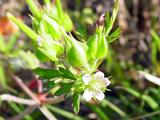
We did indeed go to the website DESERTUSA recommended by your friend and, frankly, we don't know where to start. We searched on the web by the Latin name, Erodium cicutarium, and found a number of webpages, most of which were under the title of things like "weeds", "noxious weeds", "invasive plants" or "Integrated Pest Management." Then, we discovered that, while there are native Erodiums, members of the Geranium family, this is a non-native, native to Eurasia, and imported to the New World by early Spanish settlers. The focus of the Lady Bird Johnson Wildflower Center is the care and propagation of plants native to North America, but a very large part of our work also has to do with the control or elimination of invasive plants, whether native or non-native. In point of fact, we don't want to do anything to encourage the propagation of this plant anywhere in the United States.
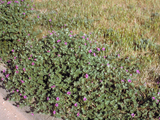
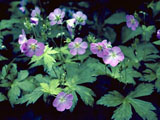
Filaree is an attractive plant, with its little five-petalled flowers. Perhaps we could suggest some other member of the Geraniaceae Family that are native to North America, not considered invasive and could grow in a garden in Illinois. The first, Erodium texanum (Texas stork's bill), has information on our webpage saying it is only native to parts of the Southwest. However, the USDA Plant Profiles Map shows it distributed as close to Illinois as Missouri, so it's a possibility. Geranium maculatum (spotted geranium) and Geranium carolinianum (Carolina geranium) are both indicated as distributed in Illinois. Now, whether you could get seeds of any of these plants, especially as they are considered weeds, is another question. The Illinois Native Plant Society, on their website, has a link to "Seeds and Nurseries." They also have a lot of material on invasive plants, so you might not have much luck there, either.
Conclusion: We'd really rather you didn't gather any seeds of the Erodium cicutarium, even if you find them.
More Non-Natives Questions
Ficus pumila on Stucco Walls
October 06, 2015 - Can the creeping fig vine damage the stucco covered walls?
view the full question and answer
Winter damage to non-native Jasminum mesnyi
May 09, 2007 - I planted 6 shrubs in 2006 that I think are some type of jasmine that have yellow flowers. Can't remember the name. I live in Lago Vista TX just outside Austin. This year 3 are doing really well a...
view the full question and answer
Care of non-native lilac
July 14, 2006 - How and when do we prune lilacs bushes ?
view the full question and answer
Survival of non-native windmill palm in Zone 6b
March 28, 2009 - Will a windmill palm survive a Zone 6b Michigan climate; if so would I have to wrap it up in burlap in wintertime?
view the full question and answer
Hybrid Campsis radicans 'Madame Rosy' from Medina OH
July 07, 2012 - I have a Madame Rosy Campsis that is not blooming. We purchased and planted it last year, mid-summer and it did well for the remainder of the season but this year...nothing but green leaves........wh...
view the full question and answer
| Support the Wildflower Center by Donating Online or Becoming a Member today. |