Native Plants

Q. Who is Mr. Smarty Plants?
A: There are those who suspect Wildflower Center volunteers are the culpable and capable culprits. Yet, others think staff members play some, albeit small, role. You can torture us with your plant questions, but we will never reveal the Green Guru's secret identity.

Did you know you can access the Native Plant Information Network with your web-enabled smartphone?

Ask Mr. Smarty Plants
Ask Mr. Smarty Plants is a free service provided by the staff and volunteers at the Lady Bird Johnson Wildflower Center.

rate this answer

Monday - January 28, 2008
From: Walnut Creek , CA
Region: California
Topic: Propagation
Title: Propagation of indoor plants for school project
Answered by: Barbara Medford
QUESTION:
I have an assignment for school that requires that I get two indoor plants. One has to grow in water and one has to grow in soil. Each plant needs to grow at a fast pace, and at about the same pace. They have to grow indoors and they need to grow within two weeks. I have to start with seeds. I live in the Bay Area and need to be able to get these plants around here. Can you tell me which plants will work? Thank you.ANSWER:
If your family likes guacamole, here is a site about using the seed to start an avocado. Basically, you're going to take the meat of the avocado off the seed, stick some toothpicks in it to suspend it in water in a cup or jar, broad side down, and set it in a warm place out of direct sunlight. Set up several seeds, if you can, because some seeds will sprout very quickly and some never will. Other seeds that sprout quickly in water are kidney beans and pinto beans. A layer of pebbles in a shallow bowl or saucer, some water, and several beans in the water will produce sprouting, sometimes within 48 hours. You didn't say how long these plants had to survive in just water. Remember, they are destined to grow up to pretty good size plants; in the case of the avocado, a medium-sized tree. When the plant in water has consumed the nutrients stored in the seed you have sprouted, it is going to need some soil to stay alive. Also, you mentioned that they needed to be indoor plants. While there are many "house plants", plants are really designed to live outside in the dirt. They can sprout and grow for a period in indoor conditions, but hopefully your project doesn't involve keeping them alive for years!
Now, if you can stretch the definition of a seed a little bit, you might try sprouting a potato. A regular white potato can be cut in half, and place the potato in a jar with the cut end in water; make sure there are some "eyes" in the water. Within about a week, roots will start to grow out of the cut end, and soon after leaves will appear on the top half. Caution: The white potato is a member of the nightshade family, and the leaves are poisonous. If you have pets or a little sister that might munch on leaves, be sure the potato plant is out of reach.
Another "seed" is a sweet potato. This time you don't cut it, but leave it whole. Again using toothpicks for support, suspend it in a jar of water, and make sure the bottom half-the pointed half- is under water. Place in a sunny spot and change or add water as needed. Two to three weeks later, leaves and stems will sprout from the top.
For seeds to be planted in dirt, you will need to prepare some potting soil in a container or flat to plant the seeds. There are plastic pots for this, or peat, you can even use a heavy paper cup, but it must have drainage holes in the bottom. Moisten the soil and put the seeds in at the depth recommended on the seed envelope. Most of them can be just barely patted down in the soil. Here is a link to a very good, detailed article on planting seeds indoors.
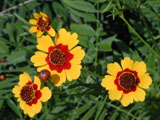
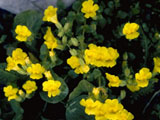
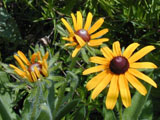
We went to our Native Plant Database and used the "Combination Search" to find native flowers that are propagated by seed, sprout quickly, and can be sprouted indoors. We searched on California, "annuals" because they are probably going to sprout more quickly than perennials, "2 to 6 hours a day of sun" and "moist soil." You could search again using different growing conditions, and read the information page on each. Some seeds need to have pre-treatment for germination and you don't have time for that, so look for quick sprouters from seed. We chose plants native to North America, because that's what we do at the Lady Bird Johnson Wildflower Center. Here are some suggestions you should check out:
Coreopsis tinctoria (golden tickseed)
Mimulus guttatus (seep monkeyflower)
Nemophila menziesii (baby blue eyes)
Rudbeckia hirta (blackeyed Susan) There is also an information sheet on the propagation of Rudbeckia hirta that you can check for further help.
Probably your best bet is to go to a good nursery where seeds are sold, and read labels on the envelopes, looking for time to sprout, etc. Don't worry about waiting until spring or fall to plant them, you are planting in an artificial environment, and not expecting them to grow to maturity. You may be forced by your time requirements to go for seeds from non-native plants, but it would be nice to stick with natives. While you're at the nursery, you can get a small bag of potting soil, and perhaps some pots. Again, plant several in different pots or a flat to ensure that at least one comes up. Good luck, we hope you sprout a green thumb!

More Propagation Questions
Seeds from opuntia
May 11, 2009 - How do I get seeds from opuntias?
view the full question and answer
Gardening book for beginner gardener
December 06, 2008 - What is a good gardening book for a beginner gardener who lives in Round Rock. Would like info for both vegetables and plants for landscaping. Thanks.
view the full question and answer
Golden groundsel plants or seeds for Bulverde TX
October 02, 2011 - Where can I find golden groundsel, plants or seeds?
view the full question and answer
Why Did Gaillardia and Aquilegia Changed Color?
June 26, 2013 - Both a Gaillardia pulchella and two red columbines bloomed normally last summer, but this summer the Gaillardia's petals are all yellow and one columbine is white and the other is yellow. What caused...
view the full question and answer
Comparative speeds of flowering from seeds or bulbs
March 24, 2006 - Does a seed flower grow faster than a bulb flower?
view the full question and answer
| Support the Wildflower Center by Donating Online or Becoming a Member today. |