Native Plants

Q. Who is Mr. Smarty Plants?
A: There are those who suspect Wildflower Center volunteers are the culpable and capable culprits. Yet, others think staff members play some, albeit small, role. You can torture us with your plant questions, but we will never reveal the Green Guru's secret identity.

Did you know you can access the Native Plant Information Network with your web-enabled smartphone?

Ask Mr. Smarty Plants
Ask Mr. Smarty Plants is a free service provided by the staff and volunteers at the Lady Bird Johnson Wildflower Center.

rate this answer

Saturday - December 15, 2007
From: Pearland, TX
Region: Southwest
Topic: Grasses or Grass-like
Title: Grasses for dry bottom detention ponds
Answered by: Nan Hampton
QUESTION:
I am working on a project for my HOA in order to reduce mowing costs and to beautify our neighborhood. We were wondering if you could help us find people knowledgeable about dry bottom detention ponds and grasses that could be used that were slow growing, required little fertilizer but could have a strong enough root structure to maintain the slopes of a detention pond(s). We are located in Pearland, TXANSWER:
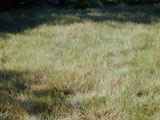
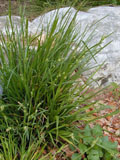
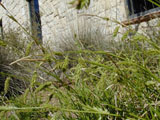
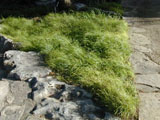
Please see our National Suppliers Directory for information about Landscape Professionals and Environmental Consultants in your area who might be knowledgeable about dry bottom detention ponds.Grasses are excellent plants for stabilizing slopes because of their extensive fibrous root systems and native grasses require no, or very little, fertilizer. If the detention pond is in a primarily sunny area, then an excellent choice for a grass is Bouteloua dactyloides (buffalograss) since it grows slowly and doesn't require frequent mowing. However, it will not deal well with standing water which may happen with your detention pond. You would probably be better off with plants that are appropriate to a raingarden situation—plants that tolerate standing in water but can also thrive when the water dries up completely. Sedges (such as Carex blanda (eastern woodland sedge), Carex cherokeensis (Cherokee sedge) or Carex texensis (Texas sedge)) are grasslike, don't grow too tall, and can withstand both wet and dry situations.
You might also consider ornamental grasses that are pleasing to look at without needing to be mowed, for instance:
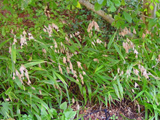
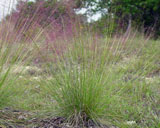
Andropogon glomeratus (bushy bluestem), Chasmanthium latifolium (Inland sea oats), and Muhlenbergia capillaris (Gulf muhly).
You can see other suggestions for raingarden plants in the answer to a previous question.

More Grasses or Grass-like Questions
Ground cover under Spruces from West Chester PA
December 06, 2012 - Trying to get a native groundcover (or any grass/wildflower/fern) planting established under a small stand of spruces. Established stand (30+ years old), so lots of needles on ground. Just about tot...
view the full question and answer
Meadow garden for Colorado Springs CO
June 03, 2012 - We recently purchased a restored home on a mesa just above the downtown area of Colorado Springs on the front range. The previous owners seeded the front lawn with blue gramma and told me that all I ...
view the full question and answer
Cork Screw Rush doesn't spiral in Whitehall, PA.
April 29, 2016 - Why won't the stems on my cork screw rush plant twist and/or spiral? It's planted outside. It was twisting and spirally when I planted it. Growing outside the past 4 years but does not twist or curl l...
view the full question and answer
Native plants to retain slope in Salisbury, CT
April 25, 2009 - We want to plant a newly dug out slope with native plants that will retain the dirt. It is sun to part sun near a lake summer cottage. Thanks!!!
view the full question and answer
Native Plants for Shaded North Slope in Ohio
January 03, 2013 - I have a shaded north hillside which needs erosion control plants. Mostly moss and very thin grass grows there now. Please help!
view the full question and answer
| Support the Wildflower Center by Donating Online or Becoming a Member today. |