Native Plants

Q. Who is Mr. Smarty Plants?
A: There are those who suspect Wildflower Center volunteers are the culpable and capable culprits. Yet, others think staff members play some, albeit small, role. You can torture us with your plant questions, but we will never reveal the Green Guru's secret identity.

Did you know you can access the Native Plant Information Network with your web-enabled smartphone?

Ask Mr. Smarty Plants
Ask Mr. Smarty Plants is a free service provided by the staff and volunteers at the Lady Bird Johnson Wildflower Center.

rate this answer

Friday - August 17, 2007
From: Pflugerville, TX
Region: Southwest
Topic: Non-Natives, Pruning
Title: Deadheading cannas and geraniums
Answered by: Barbara Medford
QUESTION:
I'm new to gardening. Your help would be appreciated. 1) I think I read that canna flowers can be deadheaded so they will continue to bloom throughout the summer. What part is actually taken off? There is a round green pod that grows directly below the blooms. Does this get cut off along with the wilted blooms? What about the stem that remains above the leaves? 2) Can geraniums be deadheaded as well? Do I just take off the wilted blooms, or can I cut the stems off as well. Thank you so much for your help!ANSWER:
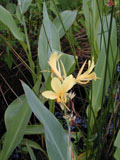
We are assuming that the cannas you are raising as ornamentals are hybridized plants, bred for spectacular color. The entire genus of Canna is native to tropical and subtropical regions of North and South America, with some in southern South Carolina and southern Texas. The native Canna glauca (maraca amarilla) is not nearly as spectacular as the hybrids available in commerce, but a lovely plant, nevertheless. In response to your question on deadheading, this website on cannas (or canna lilies, although they are not true lilies) will give you lots of information on care of these colorful plants. The bright-colored "petals" that you see are not actually part of the blossom, which is small and insignificant looking. The "flowers" are actually staminodes and Nature's intention in creating the bright colors was to attract pollinators who collect nectar and pollen. According to the information we were able to find, it is always good to cut back the entire stalk on which a flower has faded. It is such a vigorous plant that the stalk will quickly be replaced by a new one with new blooms on it.
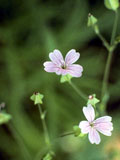
In response to your second question about deadheading geraniums, we have another question: "Which geranium?" As you know, the Lady Bird Johnson Wildflower Center is dedicated to promoting the care and preservation of native wildflowers, so we will deal first with the perennial natives that you might have in your garden in Texas: Geranium caespitosum (pineywoods geranium) , Geranium carolinianum (Carolina geranium) , and Geranium texanum (Texas geranium). These are all Geraniaceae (Geranium family). They would certainly benefit from deadheading, and it would contribute to more blooming.
It is more likely, however, that you are asking about members of the genus Pelargonium, for which "geranium" is the common name. These are subtropical in origin and, like the cannas, have been heavily hybridized in commerce. They are often used in pots for decorative purposes, and should be treated as annuals. Certainly remove blossoms that have begun to fade and dry, taking off the stem to the next joint. They can be broken off, but are better snipped with garden scissors. And snap off any dead leaves at the same time.
More Pruning Questions
Arrows and Hunting Dogs in Kentucky
December 09, 2009 - Mr. Smarty Plants--Is it normal for our arrowwood viburnum to give off a musky odour in the late fall? The smell reminds me of a wet hunting dog.
view the full question and answer
Pruning tips for Texas Mountain Laurel.
October 09, 2011 - Towards the end of May, I planted some Mountain Laurel seeds in pots. They are about six inches high now and starting to branch out. Do I need to trim off the leaves on the main stem below the branche...
view the full question and answer
Mimosa shape
November 27, 2007 - I planted a summer chocolate mimosa, and although it has bloomed lovely foliage, it has two main branches growing in a vee shape. Is this normal? Do I need to do anything to spur the growth in a more ...
view the full question and answer
Repairing Previous Silver Maple Pruning Damage
May 09, 2015 - I cut a limb off my silver maple wrong and now the trunk is developing a hole. What is the best treatment?
view the full question and answer
Decorative Trees for Scenic Bench in Fairhope IL
June 10, 2012 - I am looking for a recommendation for a pair of small trees (does not grow taller than 18-20 feet) that can provide shade on either side of a stone bench. The site is in full sun, western exposure an...
view the full question and answer
| Support the Wildflower Center by Donating Online or Becoming a Member today. |