Native Plants

Q. Who is Mr. Smarty Plants?
A: There are those who suspect Wildflower Center volunteers are the culpable and capable culprits. Yet, others think staff members play some, albeit small, role. You can torture us with your plant questions, but we will never reveal the Green Guru's secret identity.

Did you know you can access the Native Plant Information Network with your web-enabled smartphone?

Ask Mr. Smarty Plants
Ask Mr. Smarty Plants is a free service provided by the staff and volunteers at the Lady Bird Johnson Wildflower Center.

rate this answer

Tuesday - May 01, 2007
From: austin, TX
Region: Southwest
Topic: Trees
Title: Large tree and smaller specimen tree for Austin, Texas
Answered by: Nan Hampton
QUESTION:
We are in the process of removing two Silver Maples in our front yard planted by the previous owner of our house. We live close to the Wildflower Center and have very shallow soil on top of rock. We would like to plant a relatively fast growing tall tree and a smaller, blooming or "specimen" tree in front of it. The trees would be in full sun, in summer, until the shadow of the house hits them, about 700pm. The house faces north and is serviced by a sprinkler system. Trees we have been considering are Burr Oak, Chinkapin Oak, Big- toothed Maple, American Elm (princenton or valley forge) or Texas Ash. For the smaller trees maybe a Mexican Buckeye or Eve's Necklace. Any info or suggestions you may have on these or others? It is such a huge decision to make and we are getting such conflicting information. Thanks.ANSWER:
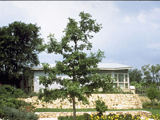
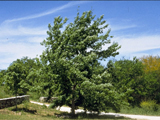
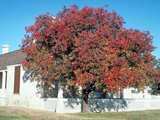
Quercus macrocarpa (bur oak) is a fast-growing, long-lived, beautiful tree with large leaves and large acorns. Some people don't like dealing with those large leaves and acorns when they fall, but others find them charming. Some even think that the large leaves are easier to rake when they fall. The bur oak, according to Sally and Andy Wasowski (Native Texas Plants: Landscaping Region by Region), is "the most widely adaptive oak in the world." It likes growing in rich bottomlands where it can become very large, but it also grows on thin soils as well. It tends to grow a large canopy which forms a large shade area. For that reason it shouldn't be planted too near buildings.Quercus muehlenbergii (chinkapin oak) is also a relatively fast-growing oak that shows little problem with pests or diseases. It is also very attractive. It tends to grow tall and narrow and generally doesn't form a broad canopy like the bur oak. According to the Wasowskis, it is sensitive to lawn chemicals and atmospheric contaminants such as car exhaust and therefore doesn't usually do well on a very busy street.
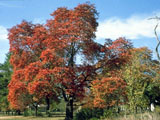
Acer grandidentatum (bigtooth maple) usually reaches less than 1/2 the height of the two oaks which can grow as high as 80 to 90 feet. According to Jill Nokes (How to Grow Natives Plants of Texas and the Southwest) it prefers growing in moist canyons and doesn't fare as well in open dry rocky hillsides. It has an attractive shape and its fall foliage is spectacular.
Ulmus americana (American elm) is also fast growing and can reach heights as great as the oaks. It shape can be variable from tall and slender to broad and arching. Both Nokes and the Waswoskis warn about the surface roots of the American elm wandering and causing problems with sidewalks, especially in heavy clay soils. Both also caution about being sure that the tree you buy from a nursery is from a stock that is tolerant of heat and alkaline soils and not one adapted to cooler eastern climes.
Fraxinus texensis (Texas ash) maximum height is similar to the bigtooth maple and has a pleasing shape and also has attractive fall foliage. It is fast-growing and drought tolerant.
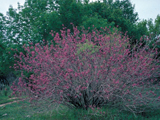
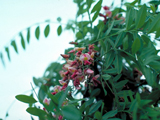
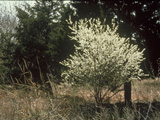
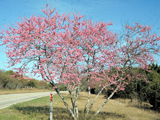
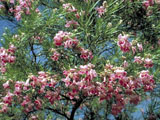
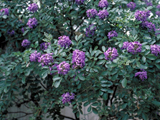
For smaller flowering trees, Ungnadia speciosa (Mexican buckeye), Styphnolobium affine (Eve's necklacepod), Prunus mexicana (Mexican plum), Cercis canadensis var. texensis (Texas redbud), and Chilopsis linearis (desert willow) are all fast-growing with showy flowers and should do well in your area. If you want an evergreen, there is Sophora secundiflora (Texas mountain laurel) with its beautiful scented purple blooms; however, it is not particularly fast-growing.
More Trees Questions
Damage to Pine Tree on Cape Cod, MA
June 11, 2013 - My pine tree on Cape Cod has bark that is perforated with holes covering the entire tree. Bark can be removed by hand. Looks dead. What did this?
view the full question and answer
Native trees for property in Washington State
September 29, 2008 - We bought a piece of property on Lake Wenatchee, Washington. It was cleared more than we would like and want to know what types of trees grow well there and can handle the snow. Should I wait until ...
view the full question and answer
Large oak with possible Laetiporus fungus
November 29, 2011 - We have a huge oak tree in front of our new house. After the first rain this fall a large fungal growth appeared in an old knothole of the tree and I would guess that it is Laetiporus.
A neighborho...
view the full question and answer
Problems with a two year old persimmon tree in Fredricksburg, TX.
May 22, 2013 - Hi Mr/Ms Smarty Plants, We planted a 4-ft Texas Persimmon, Diospyros texana, 2-years ago, with wonderful leaf and fruit production since. We recently had a hail storm (5/9/13) and although mos...
view the full question and answer
Edible forest garden for northern Minnesota
March 07, 2014 - I am planning an edible forest garden for northern Minnesota. Can you suggest a list of plants that are native to this area. We are in zone 3a or 3b. Thank you!
view the full question and answer
| Support the Wildflower Center by Donating Online or Becoming a Member today. |